RDMA Network Scaling Costs in AI Training Clusters
Hidden congestion management costs make RoCEv2 Ethernet expensive at scale.
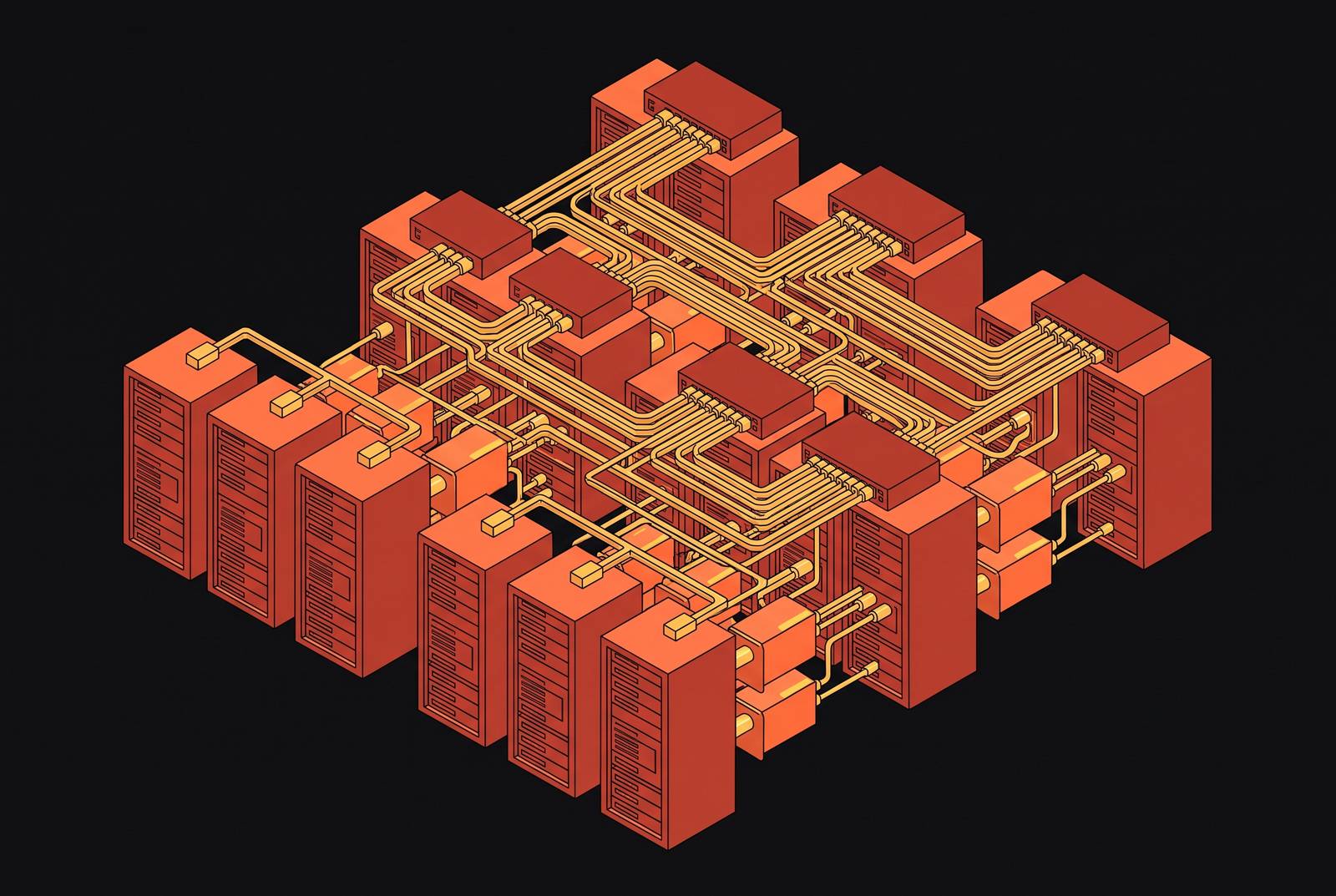
RDMA scaling costs in AI training clusters pile up in layers: hardware fabric, protocol overhead, congestion management, and the ongoing engineering labor of keeping thousands of GPUs talking to each other without stalling. None of these layers is optional, and none of them appears in full on a bill of materials. Understanding where each cost originates, and why it compounds the way it does as a cluster grows, is what separates a training fabric that holds up at scale from one that quietly bleeds GPU-hours.
Why RDMA is non-negotiable for large-scale distributed AI training
Large-scale distributed training depends on collective operations, chiefly all-reduce and all-to-all, that force thousands of accelerators to synchronize at every step. The slowest transfer in that exchange sets the pace for the entire job, so any delay anywhere in the network becomes a delay everywhere. RDMA, remote direct memory access, lets one device read or write another device's memory across the network without routing that traffic through the CPU first. That direct path removes the latency and CPU overhead that would otherwise cap how much of a GPU's time actually goes toward useful computation.
Meta's engineering team has put this in plain terms: in inference, slow communication between distributed model shards raises response times for hundreds of millions of users, and even small amounts of network friction strand real compute capacity. In training, the effect runs deeper, because collective operations synchronize thousands of accelerators at once and the slowest transfer governs the pace of the whole job. At that point, network latency becomes a direct multiplier on training time.
Losslessness follows from the same logic. A fabric that drops packets forces retransmissions, and retransmissions on a synchronization-bound job don't just slow one GPU down, they stall the barrier every other GPU is waiting on. That makes zero packet loss a requirement of the workload, not a premium feature some vendors offer and others skip. Every cost discussed in this piece, from fabric choice to topology to day-two operations, exists because this one constraint has to be satisfied at every scale.
The first cost fork: choosing between InfiniBand and RoCEv2 fabrics
The biggest single decision in building an RDMA fabric is whether to use InfiniBand or RoCEv2 over Ethernet, and that decision doesn't have one right answer. It flips depending on how large the cluster is expected to get.
InfiniBand delivers lossless, deterministic performance as a native property of the fabric. RoCEv2 achieves the same lossless guarantee by layering software and protocol mechanisms on top of commodity Ethernet hardware, which costs less to buy but asks more of the people running it. The question of whether that approach actually works at scale has been answered. An ACM paper on scaling large language model training with RDMA over converged Ethernet shows RoCE powering real distributed training workloads, which puts Ethernet fabrics in the category of a legitimate design choice for serious training clusters.
Below a certain cluster size, RoCE captures most of InfiniBand's performance at meaningfully lower cost, and the gap that remains is small enough to live with. Past that threshold, the calculation changes. InfiniBand's congestion control produces faster all-reduce operations, and because all-reduce runs constantly through a long training job, even a modest per-operation speed advantage adds up to real savings in wall-clock time and GPU-hours by the end of the run. The gap in hardware and total cost of ownership between a mid-size InfiniBand build and a comparable Ethernet build is substantial, so InfiniBand's premium has to be justified by the scale and nature of the workload, not chosen out of habit or brand preference.
There's a procurement dimension to this choice that rarely appears in a spec sheet comparison. Pressure on the InfiniBand supply chain has lengthened lead times and pushed more buyers toward open Ethernet alternatives. That kind of availability risk belongs in the total cost of ownership calculation right alongside switch prices and cabling costs, because a fabric that can't be delivered on schedule has its own cost in delayed training runs.
The hidden cost of lossless Ethernet
Choosing RoCEv2 over InfiniBand lowers the hardware bill, but you take on a layer of active engineering work that a sticker-price comparison won't capture. Ethernet doesn't guarantee lossless delivery on its own, so the fabric needs mechanisms bolted on to force that guarantee, and those mechanisms carry real costs of their own.
Priority Flow Control, the primary tool for preventing packet loss on converged Ethernet, works by pausing traffic on a dedicated class before a switch buffer overflows. That requires setting aside substantial buffer headroom and managing a traffic class most Ethernet deployments never needed before. Alongside PFC sits another congestion-control scheme, and it combines congestion marking in the network with a rate-based controller running on the host channel adapter. Getting DCQCN tuned correctly across a fabric with thousands of nodes isn't something an engineering team configures once and leaves alone. Traffic patterns shift as workloads change, and the tuning has to track them continuously.
Standard RoCE compounds this by requiring that frames arrive in order, which rules out packet spraying, the technique that spreads traffic across many paths to get better throughput on multiplane and large-scale fabrics. That creates a direct conflict: the in-order requirement that makes losslessness tractable also blocks the one technique that would make the fabric faster at scale.
The clearest illustration of what this operational overhead looks like in production comes from the ACM study of a 60-node RoCE cluster. A single straggler node was quietly dragging down throughput for the entire job, and finding it required targeted benchmarking using binary search, a multi-step engineering process rather than something a monitoring dashboard flagged automatically. The throughput loss affected the whole cluster for as long as the node went undetected. That is the kind of cost that never appears next to a switch's price tag but raises every invoice for GPU time spent waiting instead of computing.
How MetaRoCE reframes the congestion management cost equation
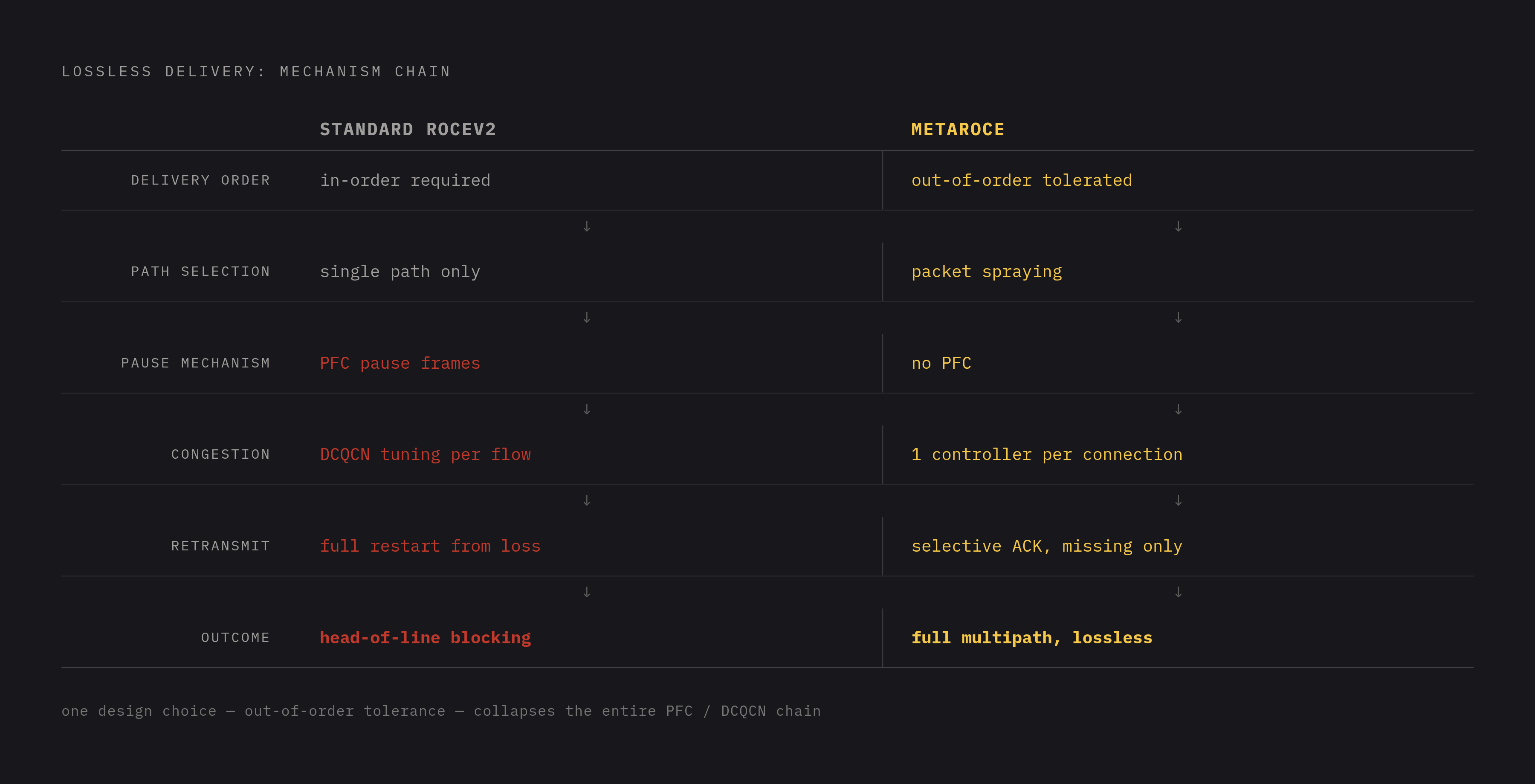
Meta built its MetaRoCE protocol to remove the PFC and in-order delivery problems described above, and the industry is watching it closely because it represents a real architectural rethink. Meta is contributing the MetaRoCE specification publicly through the Open Compute Project, along with a reference software implementation and a compliance test suite, and it plans a formal release at the 2026 OCP Global Summit in October.
The core idea, as Meta's engineering team describes it, is that the fabric sees packets, but the NIC sees intent. Moving that intelligence to the endpoint lets the protocol break the network into many fine-grained logical paths, each carrying its own real-time telemetry: per-path round-trip time, ECN state, and utilization. Instead of treating out-of-order packet arrival as an error condition that has to be prevented at all costs, MetaRoCE treats it as the normal case. Packets spray across many paths and get written straight to their final location in memory as they land, with no reorder buffer and no head-of-line blocking standing in the way. That single design choice removes the core penalty that PFC exists to manage.
MetaRoCE doesn't ask the fabric to be lossless. It doesn't send PFC pause frames. Instead, per-path selective acknowledgment catches a missing packet the moment a gap appears, and it retransmits exactly that packet, nothing more. Because the protocol tolerates loss and out-of-order delivery by design, it can spray traffic across paths packet by packet, with the NIC choosing which plane to use on multiplane fabrics, something standard RoCE's in-order requirement simply forecloses.
MetaRoCE solves connection-state growth the same way. A single MetaRoCE connection carries many independent ordered streams on top of many physical paths underneath, and one congestion controller manages all of them. Connection state stops growing as workload parallelism increases, which is a direct reduction in scaling cost for the largest clusters, the ones where queue-pair proliferation becomes a real memory and management burden under standard RoCE.
None of this requires special switch hardware. MetaRoCE runs on what switches already support, ECN marking and ECMP, and works across fat-tree, multiplane, deep-buffer, and shallow-buffer fabrics without relying on any proprietary feature. That keeps the fabric hardware itself commodity, while moving the sophistication into the NIC and the protocol. By releasing the specification, a reference implementation, and a compliance test suite through OCP, Meta is putting this design in front of the rest of the industry rather than keeping it proprietary, which matters for anyone deciding today whether to build toward this architecture or keep investing in the PFC-based model it's meant to replace.
Bandwidth provisioning and the compounding cost of interconnect underinvestment
Interconnect bandwidth doesn't affect training cost in a straight line. A faster fabric doesn't just get the job done sooner, it reduces the total number of GPU-hours the job consumes, and that distinction changes what "cost" actually means in a way a simple sticker-price comparison misses.
The mechanism is straightforward. When GPUs hit an NCCL barrier and have to wait because the network can't keep up, utilization drops. You still pay by the hour for GPUs sitting idle at a synchronization point, so every minute spent waiting raises the effective cost of each training iteration above what the hardware price alone would suggest. Higher NIC bandwidth shortens wall-clock training time, and a shorter run compresses the whole window over which power, cooling, and GPU-hour costs pile up. Measured against the cost of the full training run rather than the cost of the network component alone, the apparent premium of a faster interconnect often shrinks or disappears.
Juniper's white paper on AI networking frames fabric efficiency, capacity, scale, and performance as factors that collectively determine GPU utilization, because the network sits in the critical path for every collective operation a training job runs. Any friction introduced there reduces how much work the most expensive hardware in the cluster, the GPUs themselves, actually gets to do.
The objection that a faster fabric costs more upfront and might never earn back that premium has merit, but only under specific conditions: when utilization is already high and the real bottleneck is somewhere else in the pipeline. But for large-model training dominated by heavy all-reduce traffic, that condition rarely holds. The fabric is almost always the binding constraint, which makes underinvesting in bandwidth one of the more expensive mistakes available in cluster design, because the cost doesn't stay contained to the network budget. It spreads across every GPU-hour the slow network forces the cluster to pay for.
Topology and scale: how fat-tree and rail-optimized designs change cost structure as clusters grow
Fabric topology is where RDMA scaling costs compound hardest, because the number of switches, cables, and ports needed to keep full bisection bandwidth grows faster than the GPU count does. A topology that makes sense for a small cluster can turn into an expensive liability once that cluster grows into a large one.
Rail-optimized topologies address this by assigning GPUs to specific rails so that traffic within a rail stays on a single switch tier, cutting down the number of inter-switch hops for the collective patterns most common in data-parallel training. That's a deliberate trade: less topological flexibility in exchange for fewer switches and less cabling as the cluster scales up. Multiplane fabrics, where traffic spreads across independent switch planes, offer resilience and extra throughput headroom, but only if traffic actually gets sprayed across those planes. Standard RoCE's in-order delivery requirement limits how much spraying is possible, which is part of why MetaRoCE's native multipathing matters for topology cost as well as for congestion management. A protocol that can spray packets freely across planes gets more value out of a multiplane fabric than one that can't.
Cabling is its own cost center, and it's not a small one. The number of high-speed optical links, how long they run, and the labor needed to install and maintain them all grow with every added tier in the topology. A single bad cable in an RDMA fabric can stall an entire job, so cabling errors carry consequences well out of proportion to their individual cost.
The practical consequence of all this is that topology has to be designed around the cluster's expected final size, not its initial deployment size. Retrofitting a topology to add capacity later often means rewiring a large share of the fabric that's already in place, which turns a planning shortcut taken early into a far more expensive correction later.
Operational costs that accumulate after the fabric is built
Building the fabric is only the first expense. Running it is a continuous engineering commitment, covering congestion tuning, fault isolation, firmware management, and monitoring, and pre-deployment cost models routinely underestimate how much that commitment grows as the cluster scales.
Congestion control settings, PFC thresholds, DCQCN tuning, ECN marking points, have to be calibrated to the specific mix of traffic running on the fabric, and that calibration doesn't hold still. It drifts as workloads change, so a fabric tuned well for one training job can behave poorly on a different model or a different batch size. The ACM production study's straggler case makes the point concretely: finding the one underperforming node among 60 required binary-search benchmarking, an engineering process rather than an automated alert, and the job's throughput suffered across the board for as long as that node stayed hidden.
Queue pair management adds a less visible but equally real cost. Traditional RDMA opens many queue pairs for each pair of communicating nodes, each one carrying its own congestion state on the NIC, and that total state grows as workload parallelism increases. At large cluster sizes, that becomes a genuine memory and management burden that needs active attention on an ongoing basis. MetaRoCE's architecture addresses this directly: a single connection carries many independent ordered streams and many underlying paths under one congestion controller, so connection state stops growing with parallelism. Clusters still running standard RoCE carry the older overhead today, with no shortcut around it short of a protocol change.
None of this operational load is visible without the right telemetry. Catching congestion events before they stall a job requires infrastructure that captures per-path round-trip time, ECN marks, and flow-level statistics at fine granularity, and building that infrastructure is itself a serious engineering investment. Without it, the first sign of trouble is a throughput drop with a root cause that's difficult to pin down, which is the same operational pattern the straggler case in the ACM study made visible: the job fails quietly, and someone has to go looking for why.