Parallel vs. Distributed File Systems for Large-Scale AI Storage
How data path architecture determines whether GPUs train or idle during AI workloads.
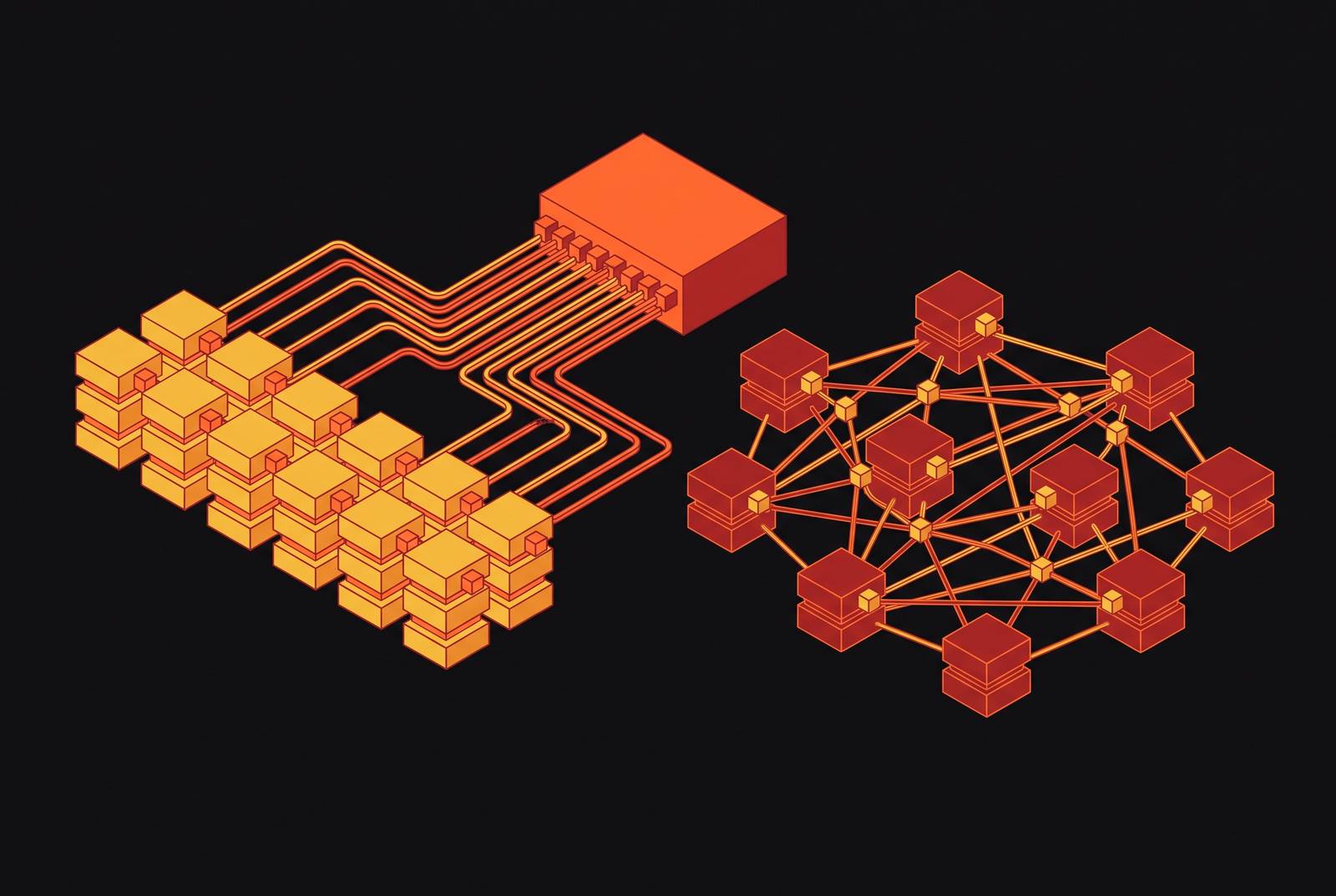
Parallel and distributed file systems get discussed as if they were two flavors of the same thing, differing mainly in scale or cost. Each one builds the data path between compute clients and storage nodes differently, and for large-scale AI training and inference, that construction choice decides whether GPUs stay fed or sit idle burning compute budget. This piece works through that structural distinction system by system, then follows it into the two places it matters most: checkpoint throughput during training and KV cache movement during inference.
Parallel and distributed file system data paths
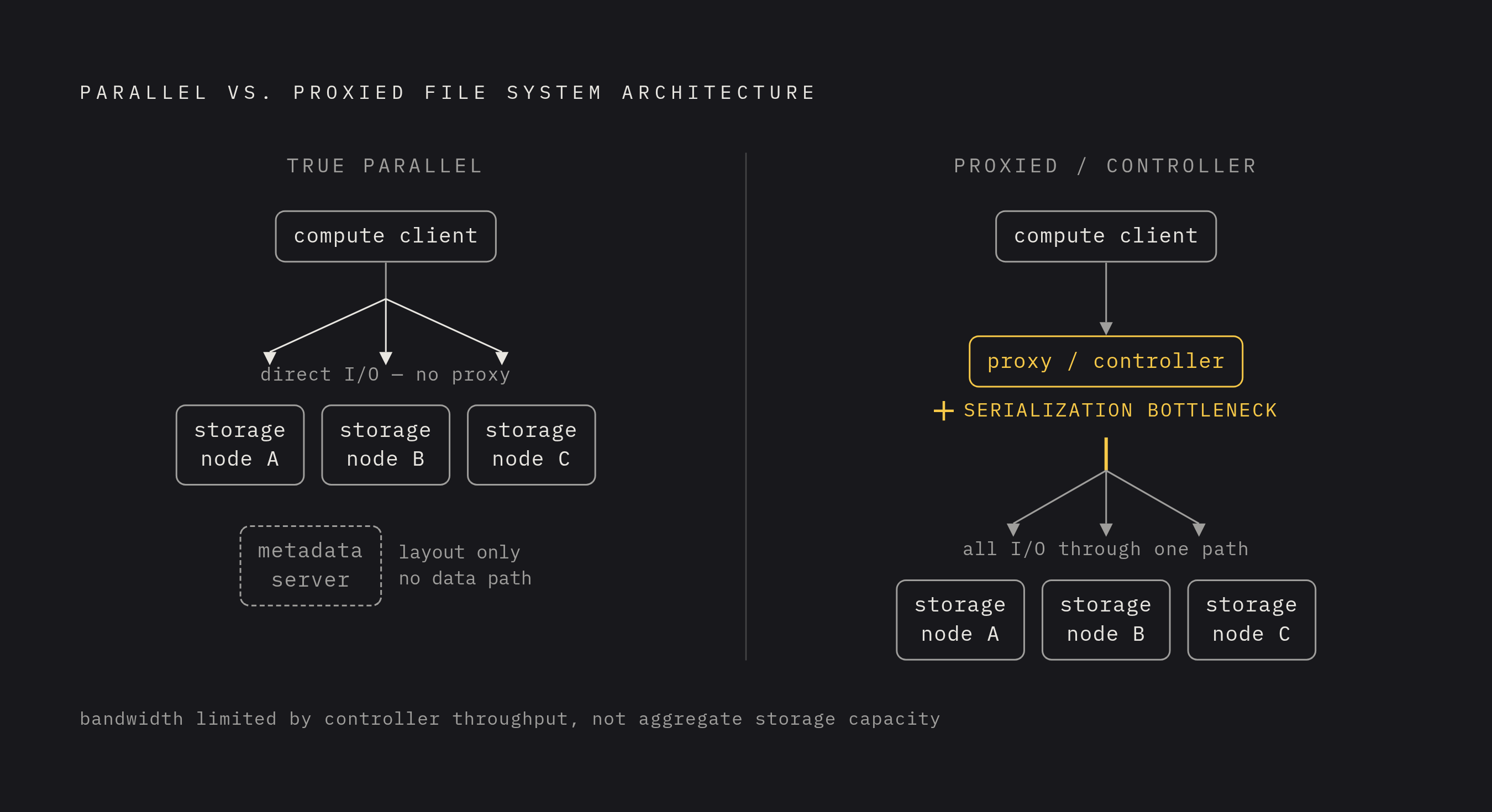
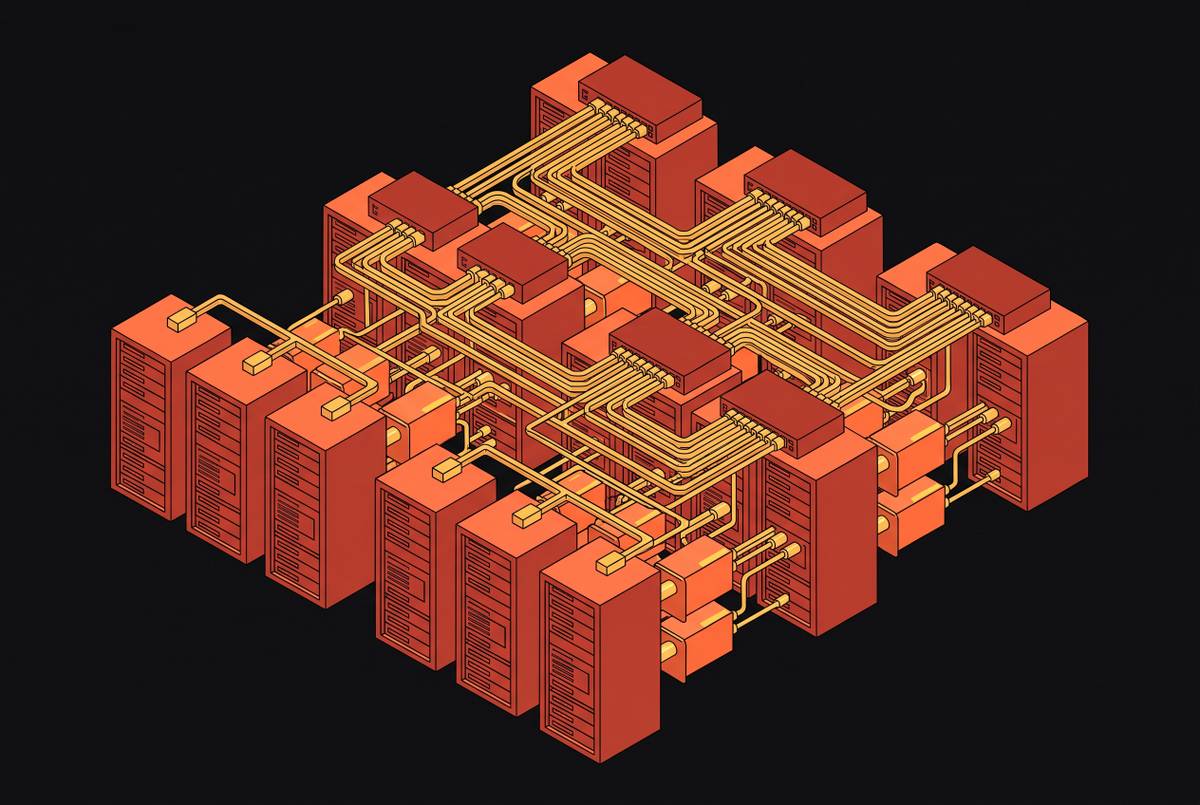
The question to ask about any storage system meant to feed a GPU cluster is simple: when a compute client needs data, does it talk to the storage node directly, or does something sit in between? In a true parallel file system, clients open direct paths to many storage nodes at once. No front-end controller, no NAS head, no proxy gateway intercepts that conversation. This is the foundational requirement that HPC architects and practitioners converge on when they define what "parallel" actually means in a file system, and it is not a matter of opinion so much as a description of where the wires run.
Distributed file systems often take a different route. Many route I/O through proxies or controllers, or they aggregate bandwidth behind front-end heads that clients hit before reaching the actual disks. The back-end capacity might be enormous, but the path to it narrows at that controller, and the system serializes requests at exactly the point where a parallel design would have fanned them out. Capacity and throughput are not the same thing, and a lot of storage shopping conflates them.
Metadata handling is the second axis that separates the two designs, and arguably the more important one. A true parallel file system keeps metadata out of the serialized path, either by distributing it, delegating it to clients, or orchestrating it in parallel across multiple nodes. There are two broad approaches here. One uses a centralized metadata server, a dedicated node or cluster that can scale horizontally in active/active configurations. The other embeds or distributes metadata alongside the data itself. Some of the more advanced designs blend the two, choosing centralized or distributed handling based on file type, file size, or how a given namespace tends to behave under load. Where metadata and data traffic end up intermingled, or where both have to pass through the same controller nodes, concurrency gets capped no matter how much raw storage capacity sits behind it.
Parallel NFS gives this principle a standards-based form that is worth understanding because it's built into infrastructure most engineers already run. pNFS, introduced in NFSv4.1 and extended in NFSv4.2, ships in all major Linux distributions. A client asks a metadata server for layout information, a map of where the file's blocks actually live, and then talks directly to the relevant storage nodes to move the data. The metadata server coordinates that layout state but never proxies the data itself. That is the same separation of concerns that defines the purpose-built parallel file systems covered later in this piece, just implemented through a protocol most Linux systems already support out of the box.
Data striping is what turns this architecture from a design principle into measurable throughput. A file gets broken into blocks and spread across multiple storage nodes. When a client reads it back, it pulls different chunks from different nodes at the same time rather than waiting on one disk to serve the whole thing sequentially. Administrators tune stripe size, stripe count, and placement policy to match the workload, and those settings are what separates a parallel file system from a wiring diagram. Separating metadata from the data path, more than any other single factor, is the test for whether a system is really parallel or merely large.
How AI Workloads Stress the I/O Path Differently Than HPC Workloads
Traditional HPC storage was designed around a specific access pattern: a handful of large, sequential files, read and written by a relatively small number of jobs at a time. Large-model AI training and inference break that pattern. The typical AI I/O profile involves millions of small, random reads, constant metadata lookups as data loaders churn through shards and samples, and concurrency levels across clients that HPC storage designers rarely had to plan for.
Checkpointing is where this is most visible. Under distributed training frameworks like ZeRO-3, each rank writes its own shard of the model state, and the aggregate write has to finish inside a target time window or the GPUs sit stalled, waiting for the checkpoint before they can resume training. For a large model stored in BF16 and checkpointed across many ranks, the minimum aggregate write throughput needed to hit a short checkpoint window runs well above what a single NFS server can sustain. Checkpoints that overrun that window don't just add latency to one operation. They leave GPUs nearly idle for the overrun period, and that idle time multiplies across every node in the job, not just the one waiting on its own shard.
Metadata is the specific point where AI workloads expose weaknesses that large-file HPC jobs never triggered. Small-file access patterns generate far more metadata requests per unit of data moved than the big sequential reads HPC storage was built around. A centralized or semi-centralized metadata service becomes a hotspot under that load, and it slows the entire pipeline behind it, a vulnerability that gets worse, not better, as the cluster grows.
Inference layers on a separate kind of pressure. KV cache I/O is high-concurrency, latency-sensitive access to comparatively small objects that have to be served fast enough to keep tokens flowing during generation, a pattern explored in more detail later, unlike the bulk sequential transfer of a checkpoint write. The common thread across both training and inference is that the architectural gap between a true parallel file system and a proxied, controller-fronted distributed system stays invisible under light or conventional load. AI workloads are what expose it, because they hit concurrency and metadata limits that traditional HPC jobs simply never approached.
GPU utilization as the metric that connects storage architecture to business cost
Storage architecture decisions appear on a balance sheet through GPU utilization, the line item that connects the two. How the I/O path is built determines how much of a GPU's paid-for compute time goes toward actual training versus sitting idle waiting on data, and that idle fraction carries a direct cost regardless of how the budget line is labeled.
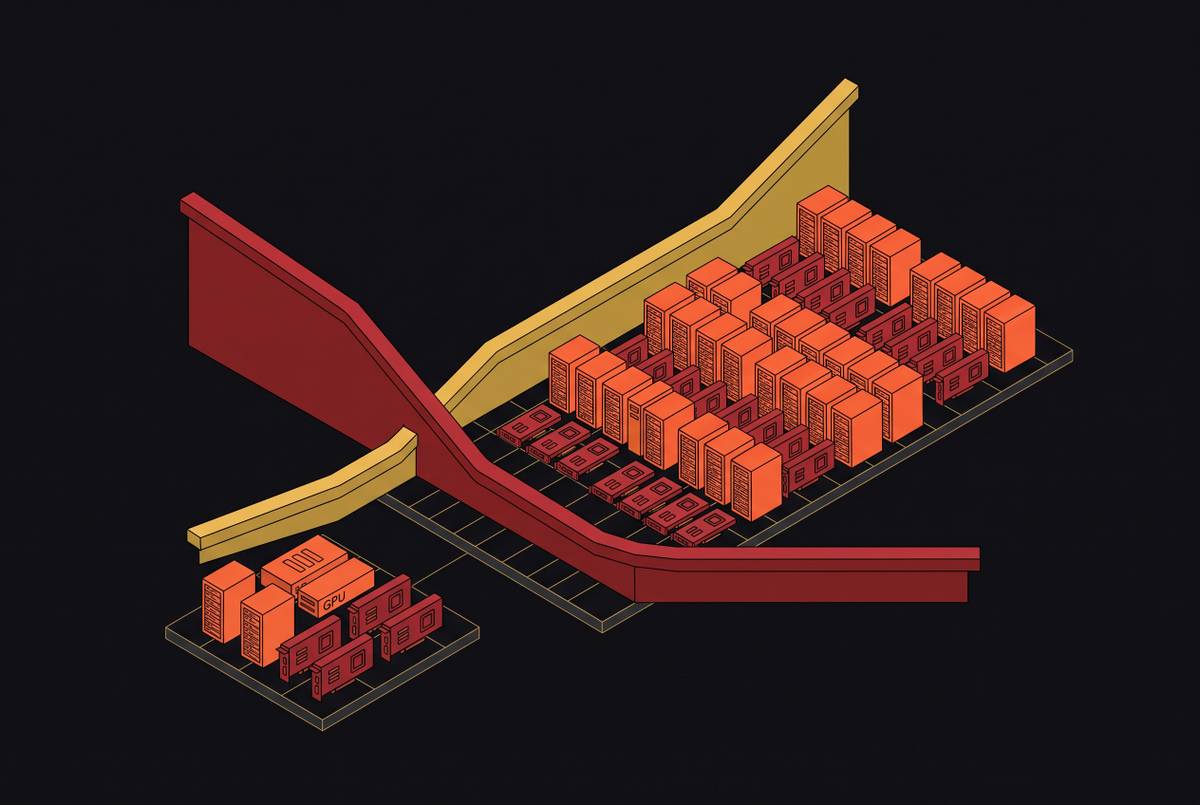
The comparison between tiers is stark. Running checkpoints against an NFS server pushed to its throughput ceiling causes GPU idle time during those checkpoints that eats a meaningful share of every training cycle. Adding enough OSTs or data nodes under a genuine parallel file system drops that idle fraction close to zero. The gap separates a cluster that trains most of the time from one that spends a visible chunk of every cycle waiting.
GPU Direct Storage changes the equation at the node level before a cluster-wide parallel file system even enters the picture. GDS removes the CPU staging step from checkpoint writes, letting GPU memory write straight to local NVMe without the usual CPU copy in between. For smaller fine-tuning jobs that don't need a full cluster-scale parallel file system, this alone can solve the bottleneck. For large distributed training runs, it's one piece of a larger throughput chain that still depends on the storage architecture behind it.
The cost argument follows directly from this. A multi-node GPU cluster running at reduced utilization because of storage stalls is still paying full compute rates for hardware that isn't computing. The case for investing in higher-throughput storage doesn't rest on storage economics at all. The GPUs are the expensive asset, and the storage is what decides whether they're earning their keep. That changes what the procurement decision has to weigh. The real cost isn't what the storage costs on its own line item, but what the GPUs cost when the storage underneath them is wrong for the job.
The architectural principle behind this, direct client-to-storage communication with no proxy gateways or front-end controllers sitting in the path, produces the same purpose-built storage systems aimed specifically at LLM workloads. Open Lake, for instance, builds around direct GPU-to-storage pathways to avoid the serialization bottlenecks that stall token generation and throughput, so the same architectural logic applies to the specific demands of LLM training and serving.
Lustre, BeeGFS, and IBM Spectrum Scale data paths
Three parallel file systems dominate large-scale AI training deployments today: Lustre, BeeGFS, and IBM Spectrum Scale. All three implement the direct-client-to-storage principle laid out earlier, but they get there through different structural choices around metadata, tiering, and operational complexity.
Lustre splits its responsibilities across three kinds of nodes. The MGS, or management server, holds cluster-wide configuration and is typically co-located with the metadata server. The MDS and its MDT handle every file create, delete, rename, and stat operation, which makes this component the metadata bottleneck for LLM checkpointing workloads that generate large numbers of small files. The OSS and OST nodes are where the actual parallelism lives, and the number of OSTs is the direct lever administrators pull to raise aggregate throughput and support DataLoader parallelism across many workers. Lustre's MDS is also its structural pressure point under AI workloads: metadata-intensive patterns concentrate load there no matter how many OSTs sit behind it. Active/active MDS configurations and DNE, Lustre's Distributed Namespace feature, address this by spreading metadata load across multiple MDS targets, though both add real operational complexity for the teams running them. Lustre is open source, it powers a large share of the world's largest HPC sites, and major GPU cloud operators now offer it as a managed service, which makes it reachable without standing up bare-metal infrastructure from scratch.
BeeGFS takes a different approach to the same problem. Rather than concentrating metadata on a dedicated server cluster, BeeGFS distributes metadata across server nodes as a native design choice. That makes it more resilient to the metadata-intensive patterns AI workloads generate, at the cost of added complexity in maintaining consistency across those distributed metadata nodes. Data striping and OST-equivalent parallelism in BeeGFS work along similar lines to Lustre's approach.
IBM Spectrum Scale rounds out the group as a commercial product, licensed under IBM's International Program License Agreement, which matters for teams weighing open-source operational overhead against a supported commercial stack.
All three systems depend on high-speed interconnects, InfiniBand or RoCE, as the fabric linking compute clients to storage nodes. The interconnect is structurally part of the data path, and any throughput number quoted for one of these systems only means something in relation to the fabric that carries it.
Legitimate Fit for Distributed File Systems and Object Storage in the AI Data Path
None of this makes distributed file systems or object storage the wrong choice. They solve different problems than a parallel file system does, and treating them as drop-in substitutes for one is what produces the bottlenecks described earlier, not some inherent flaw in the technologies themselves.
Object storage, the S3-compatible kind, is the right home for cold training data, archived checkpoints, and model artifacts that are sitting rather than being actively read. It offers high capacity at low cost per byte and can be reached from virtually anywhere. It was built for high capacity and low cost per byte rather than the low-latency, high-concurrency I/O that active training or live inference demands.
Distributed file systems with proxied data paths earn their place handling mixed workloads: legacy application access through NFS, SMB, or S3 gateways, along with edge and ingest scenarios where a proxy layer is genuinely useful. Gateway nodes in modern parallel file system designs serve this same bridging function, exposing a high-performance internal system to NFS or S3 clients externally without letting that external traffic touch the internal data path's performance.
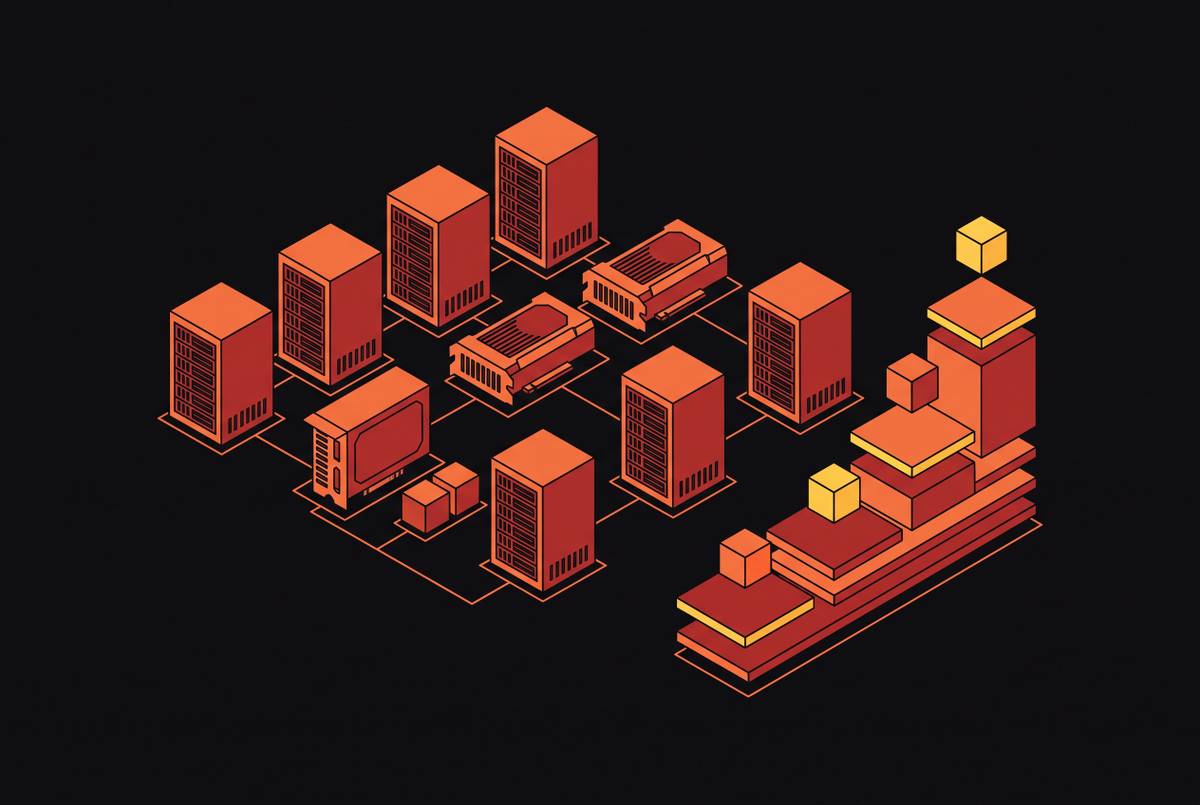
The practical shape of a large-scale AI storage architecture is tiered. Hot training data and active checkpoints belong on a parallel file system with direct client-to-storage paths. Warm or recently used checkpoints fit a mid-tier. Cold, archived data belongs on object storage, with automated tiering policies handling migration between these layers without breaking the file path clients see. An S3-compatible object storage layer, the kind Cloudian provides, is a legitimate and well-matched fit for that cold and archive tier specifically. The real question for an architecture team is where in the data path the object storage layer sits, and what tier of data actually belongs there.
KV cache I/O as a second storage pressure from inference workloads
Everything covered so far addresses training I/O: checkpoint writes, dataset reads, metadata load from data loaders. Inference introduces a separate and largely orthogonal pressure on the storage architecture, and the two should not be conflated when sizing a system. The key-value cache that LLM inference depends on grows with context length, eventually exceeds what a single GPU can hold in memory, and has to be managed across a memory hierarchy under latency requirements far tighter than anything a training checkpoint has to meet.
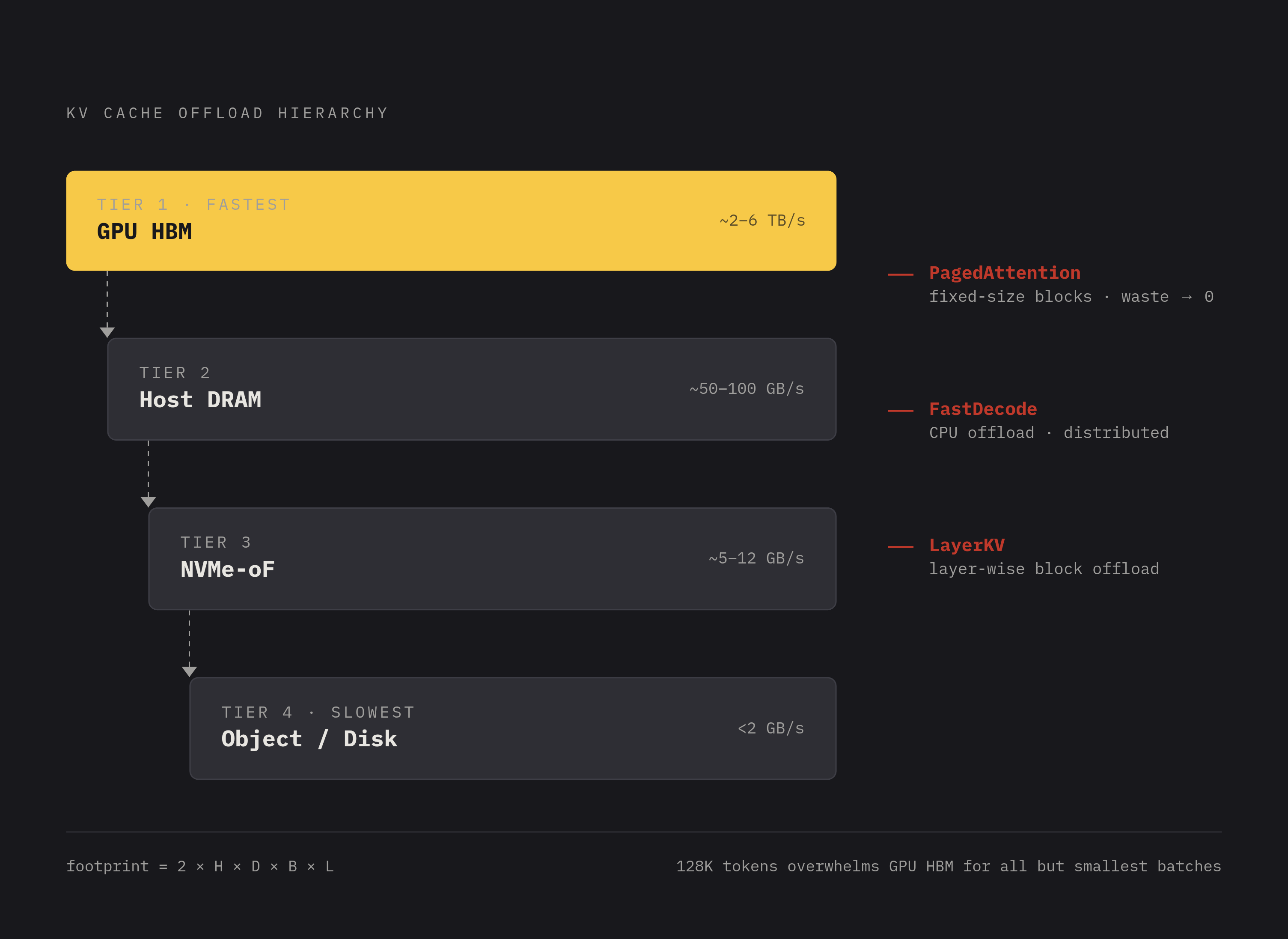
The footprint grows linearly with context length, so at long contexts a moderately sized model's cache can exceed a single GPU's capacity outright, and that forces the system to offload down the memory hierarchy. You can express cache size per token as 2 × H × D × B × L, and at context lengths around 128K tokens, that math compounds fast enough to overwhelm on-GPU memory for all but the smallest batch sizes.
Three mitigations address the memory side of the problem in production systems today. PagedAttention, introduced by vLLM, borrows the virtual memory paging model from operating systems, allocating KV cache in fixed-size blocks mapped through a page table rather than one large contiguous allocation, which cuts memory waste close to zero compared to the older contiguous-allocation approach. Prefix caching computes the KV cache for a shared prompt prefix once and reuses it across every request that shares it, which saves a substantial amount of redundant computation when a long system prompt is served to many users at once. Grouped-Query Attention reduces the structural size of the cache at the model level by sharing key and value projections across groups of attention heads.
The data residency hierarchy that results runs from GPU HBM down to host DRAM, then to NVMe-oF, then to slower storage tiers beyond that. Systems like FastDecode offload KV cache to CPU memory through distributed processing across nodes, while LayerKV uses layer-wise KV block allocation and layer-wise offloading to extend how long a context a system can serve.
KV cache I/O is unforgiving in a way training checkpoint I/O is not: it demands high-concurrency, latency-sensitive access to relatively small objects, a pattern that exposes centralized metadata hotspots and proxied data paths in ways traditional HPC workloads never did. That is precisely why infrastructure purpose-built for LLM serving treats this pattern as a first-class structural problem rather than a storage afterthought bolted on after the fact. Open Lake's approach to KV cache management across GPU and NVMe tiers is built around that premise: the cache movement between memory tiers is as architecturally significant as the checkpoint path, not a secondary concern to be handled by whatever storage system happens to be available.