Failure Rate Economics in Large-Scale GPU Infrastructure
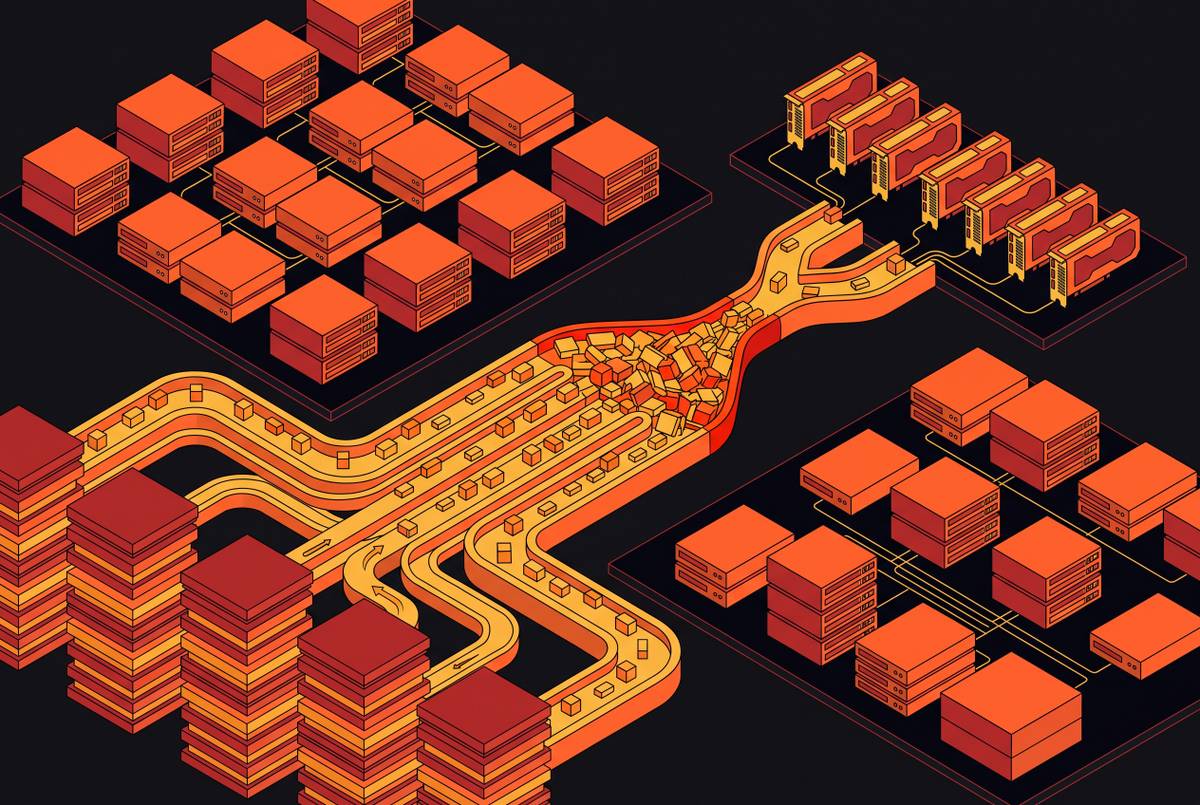
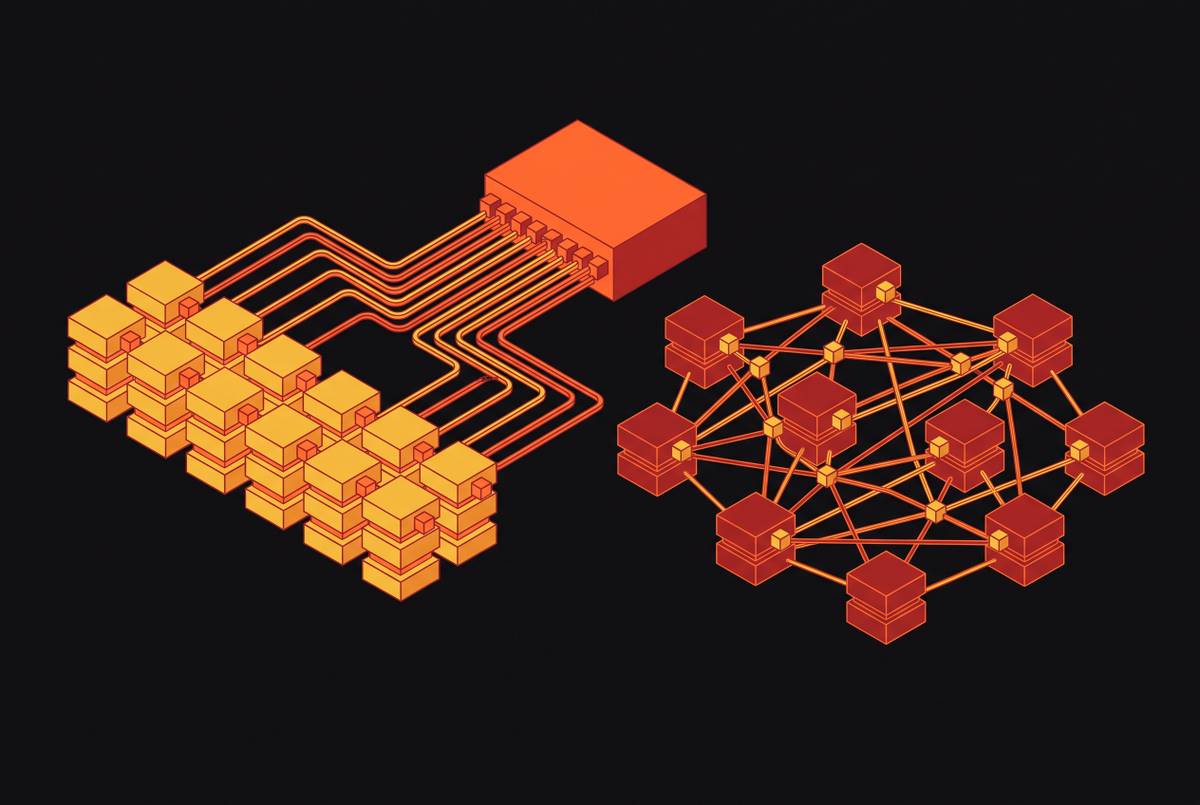
Failures become the operating condition at GPU cluster scale, not a rare risk to plan around.
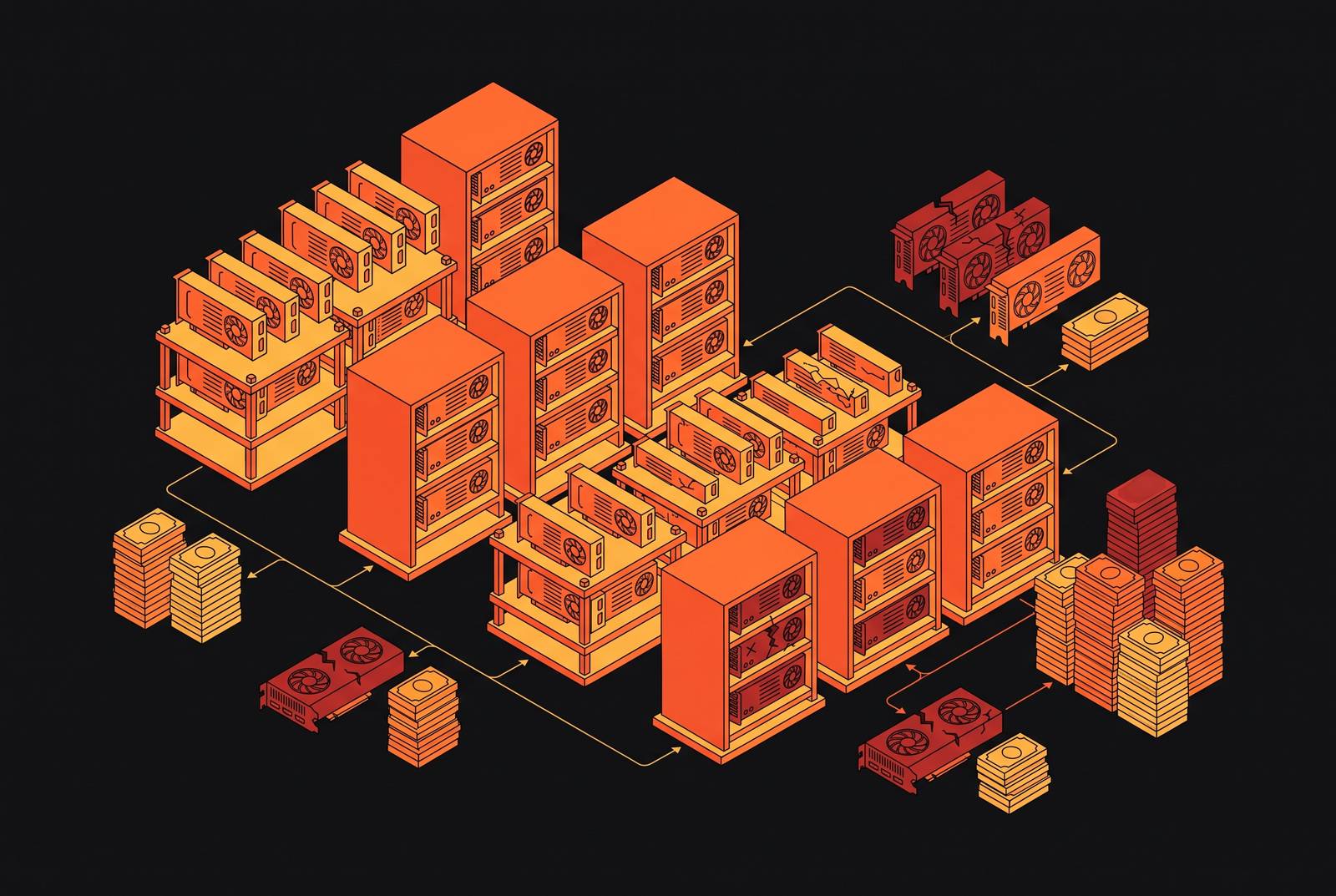
Large-scale GPU infrastructure is governed by both the economics of failure and the price of compute. As clusters grow, interruptions become an operating condition, and the combined cost of lost work, checkpointing and recovery determines how much useful work the hardware delivers. For infrastructure to be viable, storage, interconnects and automated recovery must be parts of the compute system itself.
Why failure rate is not a risk metric at GPU cluster scale — it is an operating parameter
Planning for reliability in small clusters assumes that faults are rare. Redundancy, occasional downtime and retries can be reasonable responses when failures leave long stretches of uninterrupted work. At larger scale, that assumption fails even if each component remains just as reliable. Lablup’s operational analysis of a B200 cluster describes hardware that failed repeatedly across nodes over roughly two months, with failures expected every few hours at that scale.
In distributed training, one GPU going down can stop the entire job. FailSafe’s paper identifies the same coupling in tensor parallelism, where a single GPU failure makes execution unavailable across the affected scale-up domain. The economic unit of failure is therefore the workload that stops when a device breaks. Once failure becomes the operating condition, the cluster remains viable only if it can afford the cost of responding to it.
How cluster size collapses mean time to failure and why the math is worse than it looks
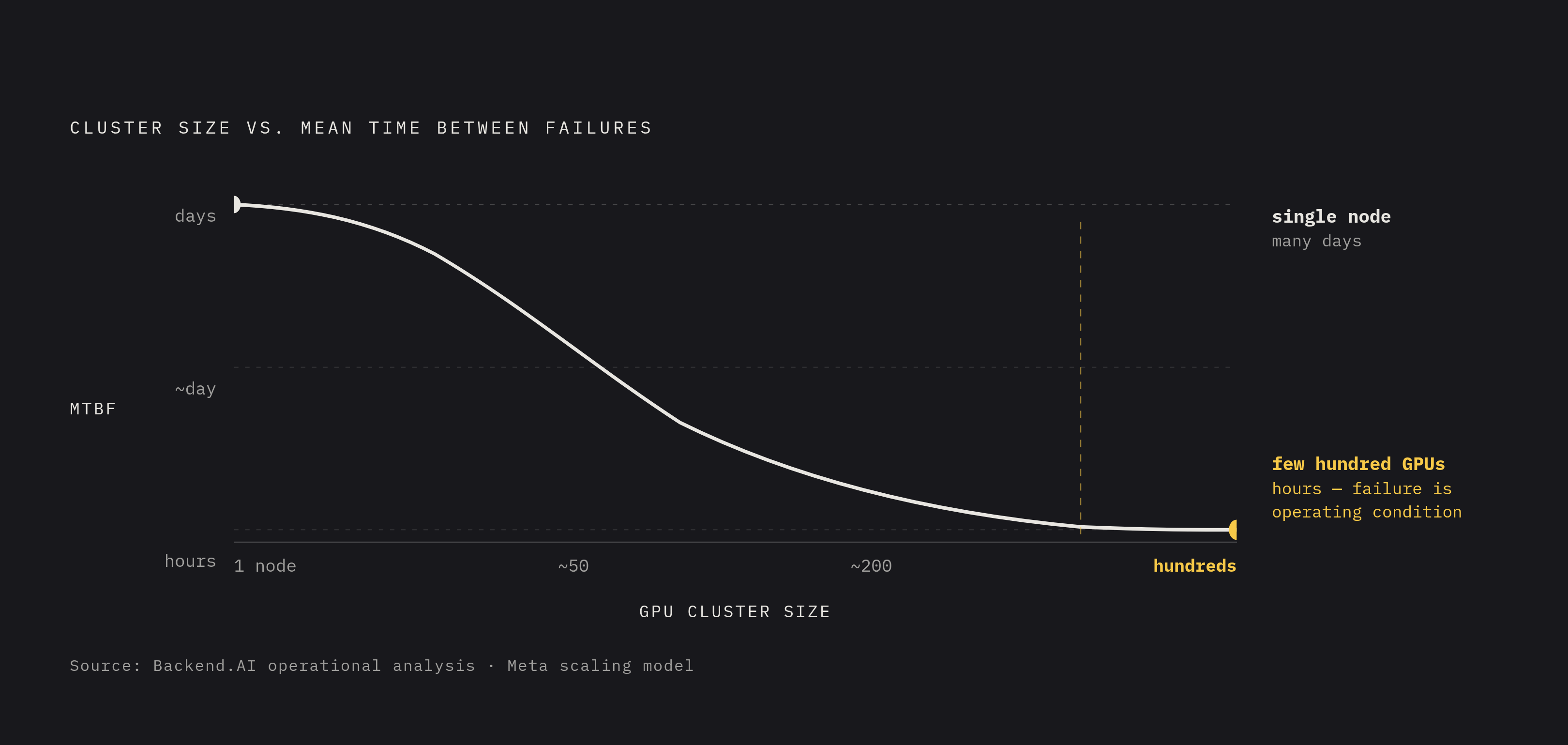
The scaling mechanism starts with the number of components that can interrupt work. When most failure modes grow linearly with component count, mean time between failures falls along an inverse curve rather than declining by a fixed amount with each added node. Backend.AI’s operational analysis, which cites Meta’s scaling model, shows the time between failures falling from many days with a single node to hours at a few hundred GPUs. The components need not become less dependable for the cluster to become much harder to operate.
Failure taxonomy matters because not every interruption has the same cause or economic effect. Meta FAIR’s HPCA 2025 analysis distinguishes hardware and software failure modes across multi-tenant ML research clusters. Hardware faults can be rare for an individual device yet collectively dominant across the fleet. Planning around an undifferentiated failure average conceals which parts of the system drive lost work. It also obscures whether work stops or continues too slowly.
A degraded GPU can hold back every other GPU in a synchronous collective without going offline. Lablup’s report cites Upstage Solar Team findings of falling TPS during multi-node scaling as an example of performance loss that can consume compute without triggering an alert. Hard failures remove execution time, while stragglers stretch the time needed to finish the same work. Together, they make useful progress a more demanding measure than apparent availability.
Why checkpointing is both the primary defense and the first cost to spiral out of control
Checkpointing limits how much completed training work a failure can erase. Its value rises as uninterrupted execution becomes less likely, but so does the cost of maintaining that protection. More GPUs require more frequent checkpoints to bound lost work, while larger checkpoint artifacts take longer to write. Checkpoint overhead therefore belongs in the training budget as a first-class cost.
The central constraint is the relationship between the failure interval and checkpoint write time. As the interval shrinks toward the time needed to complete a save, periodic checkpointing has less room to protect useful progress. If expected failures arrive sooner than a checkpoint can be written, the standard periodic model can no longer provide the intended protection. Backend.AI’s operational analysis places this inversion within reach of clusters being built today. Writing checkpoints more often cannot fix a write path that already takes too long.
A checkpoint also has value only if recovery can use it. Borrill’s crash-consistency analysis identifies substantial training waste as a consequence of failed FITO assumptions in storage stacks. The required durable-write sequence includes writing the data, calling fsync, renaming the file and calling fsync on the parent directory. Treating completion of a write system call as proof of persistence exposes recovery to missing or inconsistent state. A corrupt checkpoint can erase the benefit of the save and force a return to an earlier valid one.
Asynchronous checkpointing reduces direct GPU idle time, but it does not remove the bytes that storage must accept. Instead, it shifts the immediate constraint from blocked compute to sustained storage demand. Lablup’s profiling of checkpoint events on its B200 cluster illustrates this distinction through a “bandwidth paradox”. Only a small fraction of available RoCE bandwidth was used because the NFS RPC layer saturated first. The apparent shortage of checkpoint bandwidth was not a shortage in the network itself.
Storage is the critical path in checkpoint performance, and its bottlenecks are where engineers least expect them
The significance of that finding lies in where the constraint appeared. Lablup traced it to the concurrency limit of the NFS RPC layer, which small-node tests had not exposed. The limit showed up at production scale when many nodes wrote checkpoints at the same time. Network utilization was low because another layer kept the checkpoint workload from using the network’s spare capacity.
Checkpoint profiling must follow the full data path, beyond what a single hardware counter can show. Data starts in GPU HBM, the highest-bandwidth but smallest tier, and moves through host DRAM, local NVMe and fabric-attached storage toward durable storage. Each transition can become a choke point. Local NVMe has much higher throughput and lower latency than network object storage, but other parts of the path can still limit it. Profiling only network utilization or disk IOPS would have missed the protocol limit in Lablup’s case.
Durability creates a separate constraint beneath throughput. Borrill’s analysis identifies ext4 delayed allocation and weak crash-consistency semantics as reasons that write completion does not establish persistence. Ordering must remain correct through filesystem operations and device-level NVMe Flush and FUA behavior. A fast component cannot compensate for another layer that provides a false durability guarantee.
General storage bandwidth tests miss some of what this workload needs. Checkpoint infrastructure must absorb burst writes, deliver fast sequential reads during recovery and preserve protocol-correct durability. Large sequential saves dominate normal operation, while less frequent recovery reads become latency-critical when the job stops. Purpose-built NVMe infrastructure for AI workloads addresses those access patterns, but peak specifications alone do not establish that the complete path can serve them. The relevant performance measure is how quickly valid state can be saved and restored under production concurrency.
How GPU failure during inference serving creates a KV cache problem that mirrors training checkpoint economics
In tensor-parallel serving, a single GPU failure makes the affected execution group unavailable and destroys the failed GPU’s KV cache for in-flight requests. FailSafe’s analysis identifies recomputation of that cache as a recovery cost that must be paid before inference can continue. Model weights must also be resharded from CPU DRAM or persistent storage across PCIe. Like a missed training checkpoint, the failure forces the system to spend resources reconstructing work, delaying further progress.
Recovery does not necessarily end the loss. FailSafe distinguishes the immediate recovery overhead from persistent compute and memory imbalance when serving resumes with fewer GPUs. Attention layers partitioned by head count cannot be evenly divided across a non-power-of-two GPU count, leaving some GPUs waiting on overloaded ones. This cuts the effective batch size and keeps throughput down until the system is back at full capacity. Every request served during that interval pays for the failure, even though the service is running again.
Larger scale-up domains widen the exposure because more requests depend on the same tightly coupled group. FailSafe describes deployments that place dozens of GPUs in a single TP group, increasing the blast radius of an individual fault. Its demonstrated response combines proactive KV cache backup, cyclic placement to distribute memory evenly and hybrid attention to eliminate stragglers. That protection requires a storage layer that can absorb cache writes with low overhead and serve recovery reads without becoming the bottleneck.
Why automated failure detection and recovery is the operational lever that makes the economics tractable
Automation changes how much useful time remains between failures. When interruptions arrive faster than operators can diagnose and resolve them, manual recovery becomes part of the limiting path. Effective training time then depends on reducing both the delay before action and the time needed to resume. SIGMA provides production evidence that hardware disruption can be contained below the training framework. Its training of SIGMA-MOE encountered only one stability incident over a 75-day period while the platform absorbed hardware failures beneath that layer.
Detection can also begin before the hardware reports an explicit fault. Lablup’s analysis used hundreds of Prometheus metrics to detect every GPU failure in its XID-identified study set, including some before the XID event fired. No single metric consistently dominated across failure types, which supports multi-signal detection. The result provides evidence for precursor detection, while the predictability of every future fault remains uncertain. Its approximately 0.84 false positives per day also makes clear that preemptive exclusion has a cost that must be weighed against the disruption it avoids.
Recovery decisions must weigh how failures are spread across nodes as well as how well detection works. Lablup found that a small handful of nodes accounted for more than half of all node exclusions. In the same operational analysis, automated retry chains achieved a success rate more than twice that of manual recovery attempts, with a much shorter median retry interval.
Backend.AI emphasizes the need to understand NVLink communication within nodes, InfiniBand communication between nodes and storage connectivity before mapping metrics to failure types. A temperature anomaly can mean something different depending on a GPU’s communication role. Automation built on that context can turn frequent faults into manageable interruptions, but it cannot bypass an inadequate recovery path.
What the failure rate economics argument demands of infrastructure design choices
Infrastructure design must start with the full cost of saving useful work and restoring it after a failure. Checkpoint storage needs burst write absorption, fast sequential recovery reads and correct durability semantics as a combined requirement. KV cache backup must be built into inference serving before failures occur. Monitoring must use precursor signals when they are available and allow for false positives and nodes that keep having problems. These are connected requirements because weakness in any one can consume the gains made in the others.
Interconnect correctness belongs in the same design review as bandwidth. A misconfigured fabric can silently underperform, extending training time while making utilization problems difficult to trace. This makes fail-slow diagnosis part of the work of reliability engineering. Meta FAIR’s cluster analysis calls for infrastructure and system software that are flexible, workload-agnostic and reliability-aware. SIGMA expresses that principle through a dedicated platform layer that presents the training framework with a stable abstraction, shielding it from direct exposure to hardware faults.
Faster checkpoints matter only when they are durable, proactive backups matter only when their overhead is affordable, and quicker recovery decisions matter only when state can be restored promptly. Storage and interconnects determine those outcomes. At GPU cluster scale, failure-rate economics makes their design a condition of viability.
Sources
- Revisiting Reliability in Large-Scale Machine Learning ...
- Unix Tools and the FITO Category Mistake: Crash Consistency and the Protocol Nature of Persistence
- FailSafe: High-performance Resilient Serving
- From Detection to Recovery Operational Analysis on LLM Pre-training with 504 GPUs Lablup Technical Report
- SIGMA: An AI-Empowered Training Stack on Early-Life Hardware
- Revisiting Reliability in Large-Scale Machine Learning Research Clusters