Operational Labor Cost in AI Infrastructure Teams
Labor costs now dwarf infrastructure spend in AI projects, reshaping team budgets.
Inference now eats up more than 80% of AI GPU spend, which turns it into a FinOps line item as much as an engineering one. But the human capital side of that equation is rising right alongside it, not instead of it. Labor and integration, not API fees or per-token model costs, make up 60 to 75% of total AI project spend. That number tells you where the real cost sits: not in the model, but in the people who keep the model running.
At production scale, ongoing management, engineers and DevOps staff tuning, monitoring, and patching systems, adds $24,000 to $32,000 a month on top of infrastructure spend that already runs $25,000 to $35,000 a month. Gartner puts worldwide AI spending at $2.52 trillion for 2026, a jump of 44% year over year, with AI-optimized server purchases up 49%. A market growing that fast can't hire its way out of a labor shortage; it just makes the shortage more expensive. It just makes the shortage more expensive.
What an AI infrastructure team looks like and what each role costs
Six functional areas make up a mature AI infrastructure org: product, research, ML engineering, MLOps, data engineering, and infrastructure. Early on, one or two people wear all six hats. As systems mature, each becomes its own cost center, with its own budget line and its own hiring headache.
Two roles matter most for how these systems are operated day to day. MLOps engineers build, watch over, and maintain the deployment pipelines that connect experimental data science work to systems running in production. Model serving and inference engineers handle GPU cluster management, batching optimization, and latency service-level agreements, and meeting those agreements makes a product feel fast while missing them makes it feel broken. Skill in serving frameworks and inference optimization sits among the most sought-after specializations going into 2026.
Both ML infrastructure and MLOps roles pay $130,000 to $200,000-plus in 2026, and senior AI infrastructure engineers see total packages reach $269,000. A typical enterprise AI project team, six to eight specialists, costs $400,000 to $600,000 a year in the US. The same team built offshore in the EU runs $200,000 to $330,000, a 40 to 50% gap that partly explains why so many companies are building distributed teams rather than concentrating talent in one high-cost region.
Domain specialization prices in directly, too. Manufacturing AI work commands salary premiums of 8 to 25% over general AI roles, a clear signal that where infrastructure complexity concentrates in a specific industry, compensation follows it.
How long these roles take to fill and what happens while they sit empty
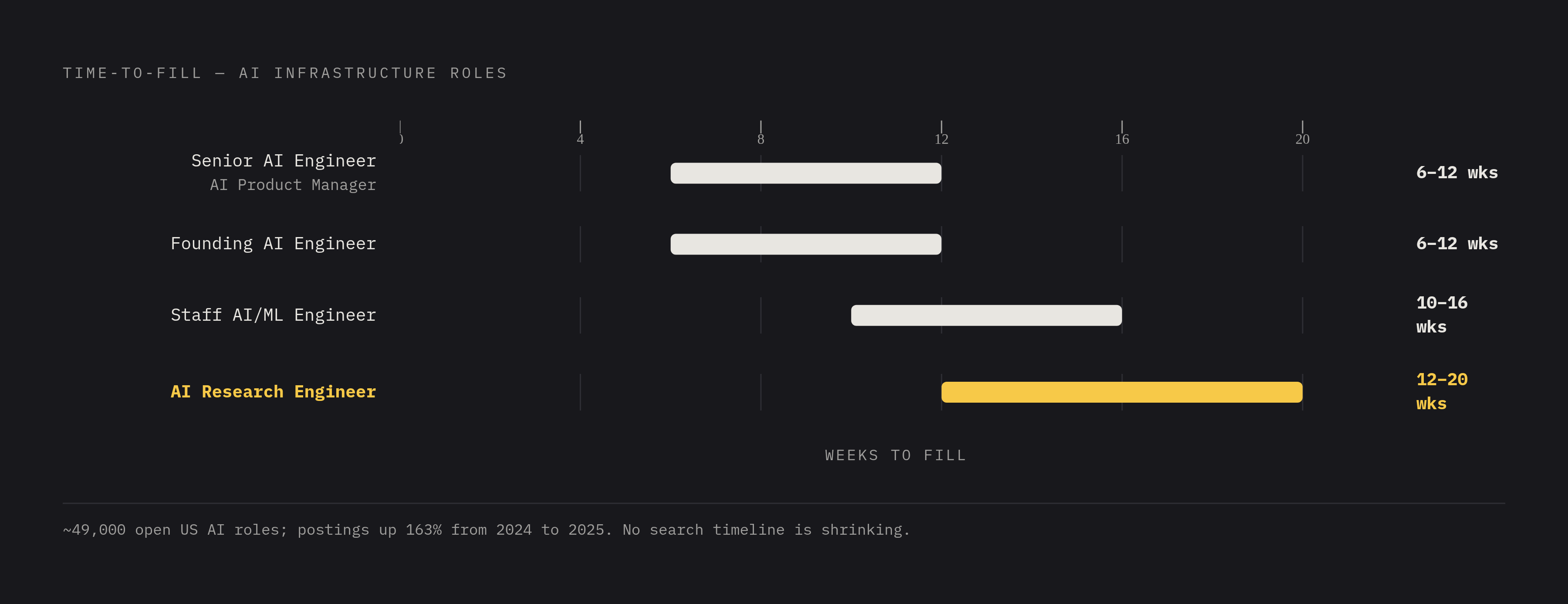
An AI research engineer is the hardest seat to fill, taking 12 to 20 weeks. Staff-level AI/ML engineers take 10 to 16 weeks. Senior AI engineers, AI product managers, and founding AI engineers land somewhere between 6 and 12 weeks, and that's with a recruiter working the search full time.
None of that timeline is shrinking. AI and ML job postings jumped 163% from 2024 to 2025, reaching roughly 49,000 open roles in the US alone. Demand for these skills is outrunning the supply of people who hold them, at exactly the moment teams most need to scale.
A lot of the delay is self-inflicted. Hiring managers routinely bundle model development, deployment work, and infrastructure management under one job title, as if they're the same skill. They aren't, and the mis-hires that result cost extra months and extra recruiting fees to unwind.
Concentrating system knowledge in one expensive specialist creates a structural risk that standard planning processes don't fully account for. When only one expensive specialist actually understands why a system is failing at 2 a.m., the organization is carrying a concentrated liability, not a resolved problem. Building redundancy against that risk means adding headcount. Better documentation doesn't fix it.
Where operational complexity concentrates in production LLM systems
A common assumption holds that LLM inference is simply a matter of adding more compute. In practice, as context lengths grow, memory capacity and bandwidth become the binding constraints, not raw calculation throughput. Optimizing it means addressing memory footprint and bandwidth, not simply scaling GPU count.
The KV cache is where that memory pressure concentrates. Its footprint scales linearly with context length, and as context windows stretch from thousands of tokens to millions, the cache runs into limits on GPU memory capacity, memory bandwidth, and total inference throughput all at once. A single Llama 3 70B request at 128K context needs 42 GB of GPU memory just to hold its KV cache, which leaves almost no room for the model weights themselves on an 80 GB card.
Three other trouble spots generate steady, ongoing operational work alongside the cache itself. Data residency decisions, where KV data actually lives across GPU HBM, CPU DRAM, local NVMe, and networked storage, create tier boundaries that each need their own operational logic and someone responsible for maintaining it. Serving scheduler behavior, continuous batching, chunked prefill, KV-aware routing, adds configuration surface that drifts every time workloads shift. And agentic workloads break the standard assumption that a cache only ever gets appended to: context in an agent loop evolves through policy-driven editing, failed tool retries, and trajectory pivots, which makes standard prefix caching insufficient on its own.
The KV cache management problem in detail, and why it generates disproportionate engineering load
Traditional inference setups waste 60 to 80% of KV cache memory to fragmentation. vLLM's PagedAttention pushes that waste under 4% and delivers 2 to 4x throughput gains as a result. That's a real fix, but it's a starting point, not the end of the problem.
A 2026 systematic review (Xu et al., arXiv:2603.20397) organizes the field into five optimization directions: cache eviction, cache compression, hybrid memory solutions, novel attention mechanisms, and combination strategies. No single technique wins across every setting, so teams have to choose, and the right choice depends on the workload in front of them.
Look at how differently methods like KIVI4, TurboQuant, SnapKV, and CaM behave across long-context workloads. KIVI4 holds the most stable quality across different models. SnapKV delivers the strongest throughput specifically on long-context tasks. CaM produces large gains on select QA workloads, but its quality and its realized compression ratio swing hard depending on the workload, sometimes for the better and sometimes not. Compression ratio by itself turns out to be a weak predictor of end-to-end performance. Engineers have to evaluate and tune these choices continuously, not set them once and walk away.
Multi-tier KV offloading stacks more operational surface on top of that. NVIDIA's Inference Context Memory Storage Platform (ICMSP), announced at CES 2026, extends GPU KV cache out into NVMe-based storage, since GPUs otherwise evict cached data and have to recompute it when HBM fills up, driving up time to first token. NVIDIA Dynamo, a distributed inference framework, supports KV cache offloading across the full path from GPU HBM to CPU DRAM to local NVMe to networked storage, with KV-aware routing and low-latency transfers handled through its NIXL library, integrated with vLLM and TensorRT-LLM. VDURA's Context-Aware Tiering, in its Phase 1 release, extends the DirectFlow buffer layer down to local NVMe SSD, aimed at long-context LLM serving and retrieval-augmented generation.
Every one of those tier boundaries, HBM to DRAM, DRAM to NVMe, NVMe to network, is a place where something can fail, a parameter that needs tuning, and a surface that needs monitoring. None of it runs itself without an engineer who understands the whole stack end to end.
How manual operations in these subsystems translate into specific headcount and cost
Running a multi-tier KV pipeline well takes engineers who hold expertise in memory hierarchy, distributed systems, and serving frameworks at the same time. That combination is what puts candidates in the $130,000 to $200,000-plus band, and why it can take anywhere from 10 to 20 weeks to fill the role, depending on seniority.
Without automated KV-aware routing, teams fall back to hand-tuning batch sizes, eviction policies, and tier thresholds by hand. That work doesn't happen once. It recurs every time context length targets change, every time a model gets upgraded, every time traffic patterns shift.
The agentic workload gap is a live tax on top of all this. Production harnesses that fall back to re-prefilling the cache on every context edit pay the full cost of prefix recomputation, over and over, on every single turn. Without a primitive purpose-built for that problem, teams face a choice: eat the added latency, or put an engineer on building a workaround, which is itself a slower and more fragile version of the same fix.
vLLM's own path toward commercialization shows that the market is willing to fund standalone companies around inference infrastructure expertise, precisely because that expertise is scarce. The market is willing to fund standalone companies around inference infrastructure expertise, precisely because that expertise is scarce. That's the same scarcity driving up the cost of hiring these skills in-house.
Where engineering investment reduces the operational labor surface
Complexity that's deterministic and repeats the same way every time can be automated away. Complexity that requires judgment specific to a workload can't be automated, and it scales with the size of the team trying to manage it. That distinction is the whole game.
Some of this is automatable today, with tooling that's already mature. Memory fragmentation is handled by default once a team runs PagedAttention in vLLM; a team paying an engineer to manage fragmentation manually is paying for something the software already does. KIVI4's consistent quality profile makes it a reasonable default for KV quantization on workloads that don't justify a full per-workload tuning cycle. NVMe-tier offloading, through abstractions like ICMSP and Dynamo's NIXL, cuts down the manual transfer logic engineers would otherwise have to write and keep maintaining by hand.
Other decisions can be reduced but not removed. Eviction policy still depends on context length, hardware limits, and the shape of the workload, and no single technique wins everywhere, so someone still has to weigh the tradeoffs. What changes is how often that decision has to get made: infrastructure designed to surface the right signals automatically cuts down how frequently a human needs to step in. Agentic cache mutation sits in the same bucket right now. It's still an active area of research, and teams running agentic workloads at real scale need an engineer capable of evaluating new primitives as they show up and mature.
Some of it can't be engineered away at all, and that's fine, because that's where the hire earns its cost. The temporal, spatial, and structural dimensions of KV cache management interact with each other, so tuning one changes the behavior of the others, and understanding that interaction takes real system-level knowledge. Workload-aware benchmarking sits here too: compression ratio alone can't predict end-to-end performance, so someone has to actually run the evaluations against real production traffic and interpret what comes back. It's the job someone has to do, not a task a dashboard replaces. It's the job.
Sources
- KV Cache Optimization Strategies for Scalable and Efficient LLM Inference
- KV Cache Optimization: Serve 10x More Users per GPU (2026) | Spheron Blog
- KV Cache Optimization: Memory Efficiency for Production LLMs
- AI Infrastructure Staffing: Build AI Compute Teams | KORE1
- activepieces.com
- recruitslab.com
- Towards Efficient Large Language Model Serving: A Survey on System-Aware KV Cache Optimization
- Benchmarking KV-Cache Optimizations across Task Quality and System Performance for Long-Context Serving