Timing AI Infrastructure Investment Against Model Generation Cycles
Faster chips won't solve the bottleneck moving into memory systems.

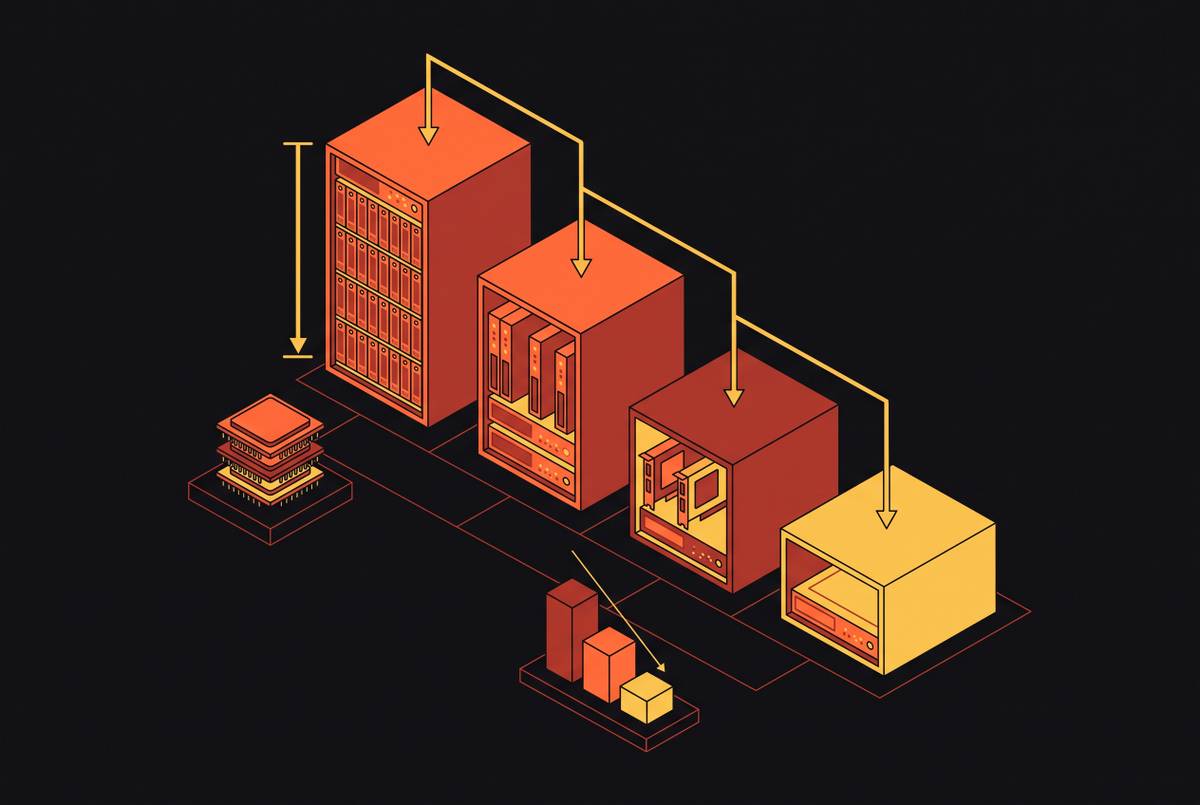
GPU generations now turn over roughly once a year, and that pace has broken the assumptions that have governed data-center procurement for a decade. NVIDIA's roadmap runs Blackwell to Blackwell Ultra to Vera Rubin to Rubin Ultra in annual steps, so hardware purchased in late 2025 gets eclipsed by Rubin within about twelve months. Traditional procurement planning assumes multi-year amortization schedules for capital equipment, and a twelve-month obsolescence window makes that model unworkable for any decision centered on the GPU itself. The money involved raises the cost of getting the timing wrong: the Big-5 hyperscalers confirmed a substantial share of a massive AI infrastructure spend for 2026 in their Q1 earnings, with the large majority of that capital now directed at AI infrastructure specifically. Research from the University of Chicago puts a number on how fast the previous generation's edge disappears: NVIDIA's Rubin GPU delivers roughly triple the inference compute of Blackwell Ultra. MLPerf Inference v6.1 results tell the same story from a different angle, showing per-accelerator gains of several times over compared to the same benchmark run one year earlier. A chip bought today is closer to a one-year lease on a moving target, and any infrastructure plan that treats GPU acquisition as the anchor decision inherits that instability.
How inference displacing training as the dominant workload changes where bottlenecks live
Training once set the terms for AI infrastructure design, but inference now accounts for the overwhelming majority of AI compute usage, and the decisions that matter most are the ones optimized for serving models, not for training them. A faster GPU does not fix a memory-bandwidth bottleneck on its own, and that single fact changes how infrastructure dollars should age. Investments in the data-movement layer, including storage architecture, the memory hierarchy, and interconnect fabric, do not depreciate on the same twelve-month cycle as GPU compute, because the problem they solve is not the problem a new chip generation resolves. University of Chicago researchers describe this as a shift in which model-side and system-side techniques for key-value cache storage and reuse have become the most effective levers for cutting inference cost and latency, more effective in many cases than raw silicon upgrades. The shift toward sparse architectures reinforces the point: MLPerf Training v6.0, published June 16, 2026, added DeepSeek V3 (671B total parameters, 37B active) and GPT-OSS 20B, both mixture-of-experts models, reflecting an industry-wide move that further changes the memory-access patterns infrastructure has to serve. The bottleneck has moved off the compute die and into the path data has to travel to reach it.
The KV Cache and Its Memory Footprint as the Central Infrastructure Constraint
The key-value cache is where that memory-bandwidth problem physically lives, and it has become the largest and fastest-growing consumer of GPU memory in production inference. During autoregressive generation, each new token has to attend to every token that came before it. Without caching, that recomputation cost grows quadratically with sequence length, which makes serving long contexts computationally infeasible. The cache solves this by storing the key and value projections from every layer for every token generated so far, but that storage grows linearly with context length, and it adds up fast. At a batch size of 32 and a sequence length of 4,096 tokens, the key-value cache for a large model reaches roughly 41 gigabytes, a figure that often exceeds the size of the quantized model weights themselves. Context windows are expanding across the industry, moving from tens of thousands of tokens toward hundreds of thousands and, in some cases, millions. This footprint problem compounds with every new generation of model capability.
Three architectural techniques have emerged to manage this burden, though none of them eliminates it. PagedAttention, introduced by vLLM, borrows the logic of virtual memory paging, allocating the cache in fixed-size blocks mapped through a page table, which cuts memory waste from a range of 60 to 80 percent down to near zero and allows substantially more concurrent requests on the same GPU. Prefix caching computes the key-value representation for a shared prompt prefix once and reuses it across every request that shares it; for a 2,000-token system prompt served to many users, that eliminates billions of tokens of redundant computation. Grouped-Query Attention, used in Llama 3 70B with 8 key-value heads shared across 64 query heads (the 8B variant uses 32 query heads against the same 8 key-value heads), achieves an eightfold reduction in cache size compared to standard multi-head attention, a model-architecture decision with direct consequences for how much serving capacity a given GPU can support. Compression at the model level is moving even faster: using Compressed Sparse Attention, the jump from DeepSeek-V3.2 to DeepSeek-V4-Pro shrank the key-value cache for 100,000 tokens by roughly nine times, from 9 gigabytes down to 1 gigabyte, within a single model generation. These gains depend heavily on what the workload looks like, since which technique actually helps is not constant across them.
Why No Single KV Cache Optimization Dominates
Compression ratio by itself predicts very little about end-to-end performance, because which key-value cache optimization wins depends on the workload running on top of it. The practical consequence follows directly: a serving system that locks itself into one compression strategy at the infrastructure level will be mismatched to some fraction of its workloads, and matching strategy to workload requires a storage and memory layer that can be reconfigured without swapping out hardware. A systematic review from Dell Technologies researchers reaches a parallel conclusion, finding that no single technique dominates across all settings and that the right strategy depends on context length, hardware constraints, and workload characteristics, pointing toward adaptive, multi-stage optimization pipelines.
Agentic workloads introduce a separate complication that compression benchmarks do not touch. Leyline, developed by researchers at the Erlangen National High Performance Computing Center, addresses this directly with a serving-side primitive that lets an agent's policy emit explicit directives, a declarative four-part structure pairing a span with its replacement, to splice the cache in place without re-running the prefill step. Between workload-dependent compression and agentic cache mutation, the lesson for infrastructure is the same: betting the serving stack on one fixed optimization strategy is a bet against the diversity of real production traffic.
The Memory Hierarchy Below HBM as the Durable Tier
Because high-bandwidth memory sits on the GPU package itself, it depreciates on the same twelve-month schedule as the chip around it. The tiers beneath HBM depreciate on a longer schedule, which makes them the more durable place to put capital. The full hierarchy runs from fast to slow: on-chip SRAM, L2 cache, HBM ranging from 80 to 288 gigabytes depending on generation, local NVMe SSDs, and remote fabric storage, with each tier demanding a different residency strategy for cache and weight data. HBM capacity does increase with each generation (the B200 carries 192 gigabytes at 8 terabytes per second, and Rubin steps up to 288 gigabytes at 22 terabytes per second), but that capacity resets with every chip cycle regardless of how much was invested in the previous one.
NVIDIA's own roadmap now treats the tier below HBM as a formal part of the architecture. At CES 2026, the company announced the Inference Context Memory Storage Platform, standardizing the offload of inference context to NVMe SSDs, and its Dynamo runtime operates across a defined hierarchy running from GPU HBM to CPU DRAM to direct-attached NVMe to networked external storage. NVMe-oF over plain TCP or Ethernet is technically supported, but it is not a substitute for the RDMA path if the zero-copy performance benefit is the point.
Production systems already validate this architecture at scale. DeepSeek's Fire-Flyer File System, known as 3FS, is a distributed storage system built specifically to meet the I/O demands of large-scale AI training and inference, tightly integrating NVMe storage with RDMA-capable networking for direct, low-latency access from compute nodes. In July 2026, Chelsio Communications announced its seventh-generation AI Interconnect Platform, delivering native 400 gigabit Ethernet alongside unified RDMA support for both iWARP and RoCEv2, along with storage acceleration, which is exactly the kind of interconnect investment that keeps paying off across more than one GPU generation. The scale of the demand on this tier is concrete: writing a 15.2 terabyte checkpoint every 30 minutes with acceptable overlap requires hundreds of gigabytes per second of bandwidth, a figure that scales with model size. A storage layer built to absorb that load keeps absorbing it no matter what sits above it on the rack.
Precision Formats and Lossless Compression in the Storage Layer
The data moving through this hierarchy has statistical structure that general-purpose storage simply ignores, and a storage layer built around that structure extracts efficiency that commodity storage cannot match, an advantage that persists for as long as the underlying formats remain in use. BF16 has become the default precision for LLM inference, with native support across NVIDIA Tensor Cores, Google TPUs, and Intel AMX, and it shows up across production models including Llama 3, Qwen, and Mistral. FP8 has emerged as the format for pulling more throughput out of the same silicon: it halves memory use per parameter relative to BF16 or FP16, shrinking a 70-billion-parameter model from roughly 140 gigabytes at BF16 down to roughly 70 gigabytes at FP8, which changes which storage and memory tier the model fits into. The layered precision strategy taking shape in 2026 keeps master weights in FP32, runs the forward pass in FP8 E4M3 through the Transformer Engine, and runs the backward pass in FP8 E5M2, a three-tier arrangement that every layer of the storage hierarchy has to handle correctly or risk corrupting the computation above it.
Compression research has moved beyond lossy quantization into lossless methods built specifically for these formats. The DFloat11 framework applies entropy coding to BF16 weights, cutting model size by roughly 30 percent while preserving full numerical fidelity, and it decompresses on the fly using GPU SRAM as a fast staging buffer during inference, which keeps the decompression step from becoming its own bottleneck. As models shift from BF16 toward FP8 or whatever format comes next, the storage architecture built to serve them has to evolve in step with the format, not with the GPU sitting on top of it, which is one more reason format-aware storage tends to outlast the hardware generation it currently serves.
How KV cache architecture is evolving toward internet-scale distribution
The key-value cache problem is outgrowing the single node it was first solved for, turning into something closer to a content-delivery problem that spans datacenters. Researchers at the University of Chicago argue that LLM inference has become a global-scale, heterogeneous workload spanning agents, retrieval, tool use, code execution, and multimodal reasoning, and that the overlap across these inputs creates a substantial opportunity to store and reuse key-value caches instead of recomputing them from scratch. The obstacle, in their account, is that current infrastructure couples compute and storage tightly within the boundaries of a single datacenter, which rules out the more efficient placement decisions that a looser architecture would allow. Their proposed framework, described as an "Internet for the KV Cache," treats cache storage and reuse as a content-distribution problem, with placement of compute and cache nodes driven by model-specific metrics, infrastructure cost, and application latency targets, with the network itself functioning as an active distribution channel.
Transferring a compressed 1-gigabyte key-value cache, representing roughly 100,000 tokens for DeepSeek-V4-Pro, over a 10-gigabit-per-second internet link is substantially faster and cheaper than recomputing that same cache on an 8-GPU B200 cluster. What it means for infrastructure decisions being made right now is that teams building on decoupled, RDMA-capable networked storage, rather than on tightly coupled, GPU-local memory, are positioned to participate in that direction when it matures, regardless of which GPU generation is doing the compute at the time.
A Generation-Agnostic Infrastructure Stack
Everything above points to the same conclusion: the infrastructure investments that hold their value across GPU generations are the ones made at the storage, memory hierarchy, and data-movement layers, because those are the layers that address the memory-bandwidth bottleneck a faster chip does not fix on its own. A serving architecture that decouples key-value cache storage from GPU-local HBM rounds out the list, since PagedAttention, prefix caching, and the ICMSP hierarchy are all steps in that same direction, and infrastructure built around that decoupling inherits future efficiency gains automatically.
Against that, two categories of investment stay tied to the chip cycle, so you should time them accordingly. HBM capacity and bandwidth on a specific GPU SKU reset with every new generation, so if you commit on-premises to a particular chip's HBM profile, it depreciates on that chip's own schedule, not on a longer one. Compute-bound training throughput tied to a specific architecture falls into the same category: Blackwell's advantage in mixture-of-experts training over prior generations is a real advantage, but Rubin resets that comparison within months of arriving.
The interconnect and orchestration layer offers a useful illustration of how durability plays out in practice. That result shows an interconnect and orchestration layer abstracting cleanly across two different GPU vendors at once, which makes that layer a more durable investment than any single accelerator sitting beneath it. The same logic applies to workload-aware key-value cache optimization: since the Bayreuth benchmark established that no single technique dominates across models and workloads, the infrastructure has to support reconfiguration. Taken together, these threads argue for the same priority: build the storage, interconnect, and memory-hierarchy layer to be flexible and format-aware now, and let the GPU generation above it change on whatever schedule the chip vendors set.
Sources
- An Internet for the KV Cache: Rethinking Classical Infrastructure Boundaries in the LLM Inference Age
- Leyline: KV Cache Directives for Agentic Inference
- KV Cache Optimization Strategies for Scalable and Efficient LLM Inference
- Benchmarking KV-Cache Optimizations across Task Quality and System Performance for Long-Context Serving