Infrastructure Refresh Cycles for NVMe Storage in AI Workloads
AI infrastructure now demands NVMe refreshes every two to three years, not five to seven.
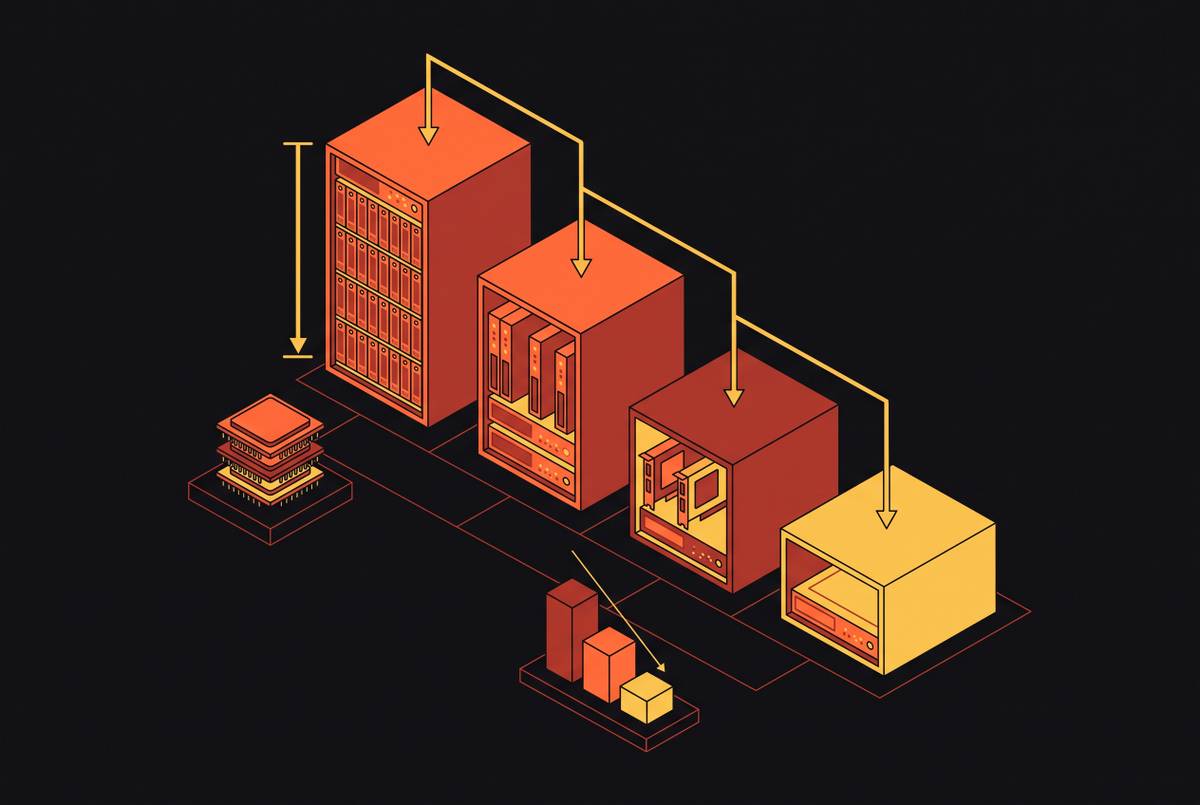
NVMe storage refresh cycles in AI data centers have compressed from 5–7 years to 2–3 years, with the pace continuing to shorten. The cause sits in the architecture itself, not in any passing market mood.
Three NVIDIA GPU generations arrived in close succession: H100 in 2022, H200 in 2024, and Blackwell GB200 in 2025. Each one improved performance per watt so much that the generation before it stopped making economic sense for large-scale inference within 18 to 24 months of going into production. Depreciation schedules were built around 5 to 7 years because, in the old hardware world, a genuine generational leap occurred only every 4 or 5 years. That assumption no longer holds for AI infrastructure, and the gap between the old schedule and the new pace of change is the whole story. Storage is not a bystander in this. Every time a new GPU generation lands, the storage layer feeding it has to keep pace or it becomes the bottleneck that cancels out the GPU spend, so storage refreshes get pulled forward on the same timeline as the compute they serve.
The GPU memory wall turns storage into an active inference component
High-bandwidth memory on a GPU is fast but small, and production LLM inference needs far more capacity than HBM can hold on its own. That mismatch pushes storage into a job it was never built for: an active, latency-sensitive piece of the memory hierarchy rather than a place where data sits until someone needs it.
The memory hierarchy on a modern AI server has six levels, running from GPU registers down to NVMe drives, and the fastest tier can work orders of magnitude faster than the slowest one. No amount of software cleverness closes that gap on its own; it has to be managed, tier by tier, with real engineering. Llama 3.1 at FP16 precision needs hundreds of gigabytes of memory, more than any single GPU's HBM can hold, so simply loading the model's weights is already a storage performance problem before a single token of inference has been generated.
By 2026, storage has become one of the main things that decides whether an AI project returns on its investment. When the storage layer can't keep a Blackwell-class GPU cluster fed, the GPUs sit idle, and the capital and power spent on them during that idle time is wasted at a scale that matters to the balance sheet. NVIDIA has started treating storage accordingly, recasting it as a core pillar of AI infrastructure rather than a passive repository, and that shift in framing is now reshaping both data center design and the supply chain that feeds it.
KV cache pressure as the specific force that wears out NVMe faster and sooner
The transformer KV cache is the single workload trait most responsible for this, turning NVMe into a high-frequency, write-heavy component that burns through both its performance headroom and its physical endurance faster than older refresh schedules ever anticipated.
The KV cache grows with every token a model generates, and at long context lengths its size can exceed GPU HBM many times over. If an H100 serves a long-context model, a single user session can need tens of gigabytes of KV state on its own, and that number multiplies as concurrent users stack up. Managing that growth has produced a now-standard offloading pattern: hot KV blocks stay on GPU HBM, warm blocks that are done but likely to be needed again in a multi-turn conversation move to CPU DRAM, and cold blocks, covering historical context and prefix caches, land on NVMe. That last step turns NVMe into a drive that reads and writes constantly.
Software already exists to manage this tiering directly. LMCache is built as an efficient KV cache layer for enterprise-scale LLM inference, handling the movement of KV blocks across the hierarchy. vLLM runs a comparable tiering model through its KV Offload API and TieringOffloadingManager, managing KV blocks across the hierarchy in production serving stacks, while PagedAttention handles block management within GPU memory itself. Research presented at OSDI 2026 by Luo and Shen, "No Buffer, No Bottleneck," introduces zero-copy KV cache offloading to eliminate the GPU staging buffers that throttle CPU-to-GPU transfer throughput on long-context workloads.
Training workloads push endurance further. QLC NAND handles the read-heavy pattern typical of inference well, but training generates write amplification that calls for higher-endurance TLC or purpose-built drives instead, and choosing the wrong media for the job shortens the time to failure. NVMe arrays doing KV cache tiering work rack up write cycles fast enough to compress their rated endurance life, which makes a 5-year depreciation schedule physically unworkable no matter when the next GPU generation shows up.
How NVMe-oF and disaggregated architectures change refresh timing
Disaggregated storage architectures cut down the damage each refresh cycle does by letting storage capacity and bandwidth scale separately from the GPU cluster, trading disruptive, all-at-once refreshes for smaller, targeted upgrades.
Older systems locked compute and storage together in fixed blocks, so scaling one meant touching the other. Architectures built in 2026 break that link: a team can add storage capacity or bandwidth without touching the GPU cluster at all, or add compute nodes without swapping out storage. This kind of disaggregation needs NVMe-oF to run at the throughput levels AI workloads demand. NVMe needs fewer CPU cycles to run than older storage protocols, so it frees those cycles up for the applications that actually use them, and as transport options for NVMe over standard networking mature alongside ordinary hardware refresh cycles, NVMe is set to become the default choice. NVMe over RoCE on 100GbE networks delivers latency under 5 microseconds with zero-copy data transfer, letting GPUs read directly from remote NVMe drives without CPU involvement, a capability that matters most for GPU-bound training jobs.
None of this comes free. Disaggregation adds real network fabric complexity, and it demands solid RDMA or NVMe-oF configuration work that many teams don't yet have the staff to run. You only get the architectural upside if you invest in fabric engineering instead of treating disaggregation as a drop-in upgrade. Evaluating whether a given storage system is ready for this kind of role no longer has to be guesswork: MLPerf Storage v3.0 includes a KV Cache workload test built to qualify candidate systems against real production inference patterns, giving teams a shared benchmark before they commit budget to a platform.
NAND supply constraints and their effect on buying timelines
The same growth in AI workloads that is compressing refresh cycles is also tightening the supply of enterprise NVMe drives, so if your team is planning a refresh, you may hit constrained allocation and higher prices just when your hardware needs replacing.
SK hynix and industry analysts describe 2026 as part of an HBM-led memory supercycle, with both DRAM and NAND revenue climbing year over year, and tight allocation combined with elevated pricing is expected to run through 2027 as new manufacturing capacity struggles to catch up with demand. Nearly every major NAND producer has shifted wafer capacity away from consumer products and toward enterprise-grade SSDs and HBM memory for AI accelerators, so the consumer drive market isn't a fallback option if your team misses its enterprise allocation window.
A new tier called High Bandwidth Flash, or HBF, was formally specified through the Open Compute Project at FMS 2026 in Santa Clara, developed by SK hynix and Sandisk alongside ecosystem partners including Google and Tenstorrent. HBF places a high-density memory tier directly between HBM and standard SSDs, using stacked 3D and "4D" NAND die configurations that provide up to 512 GB of near-compute capacity per stack. Sandisk is targeting its first HBF samples for the second half of 2026, with initial AI inference devices entering sampling in 2027, so HBF isn't a procurement option for most teams working through their current refresh cycle. It belongs in planning conversations now as a signal of what the next tier will look like, not as something to wait for.
If your team treats NVMe procurement as a spot-market purchase, made only when the need becomes urgent, you will lose out to teams that lock in forward contracts and vendor relationships before the refresh cycle hits its peak.
The compliance and decommissioning pipeline at 2–3-year refresh velocity
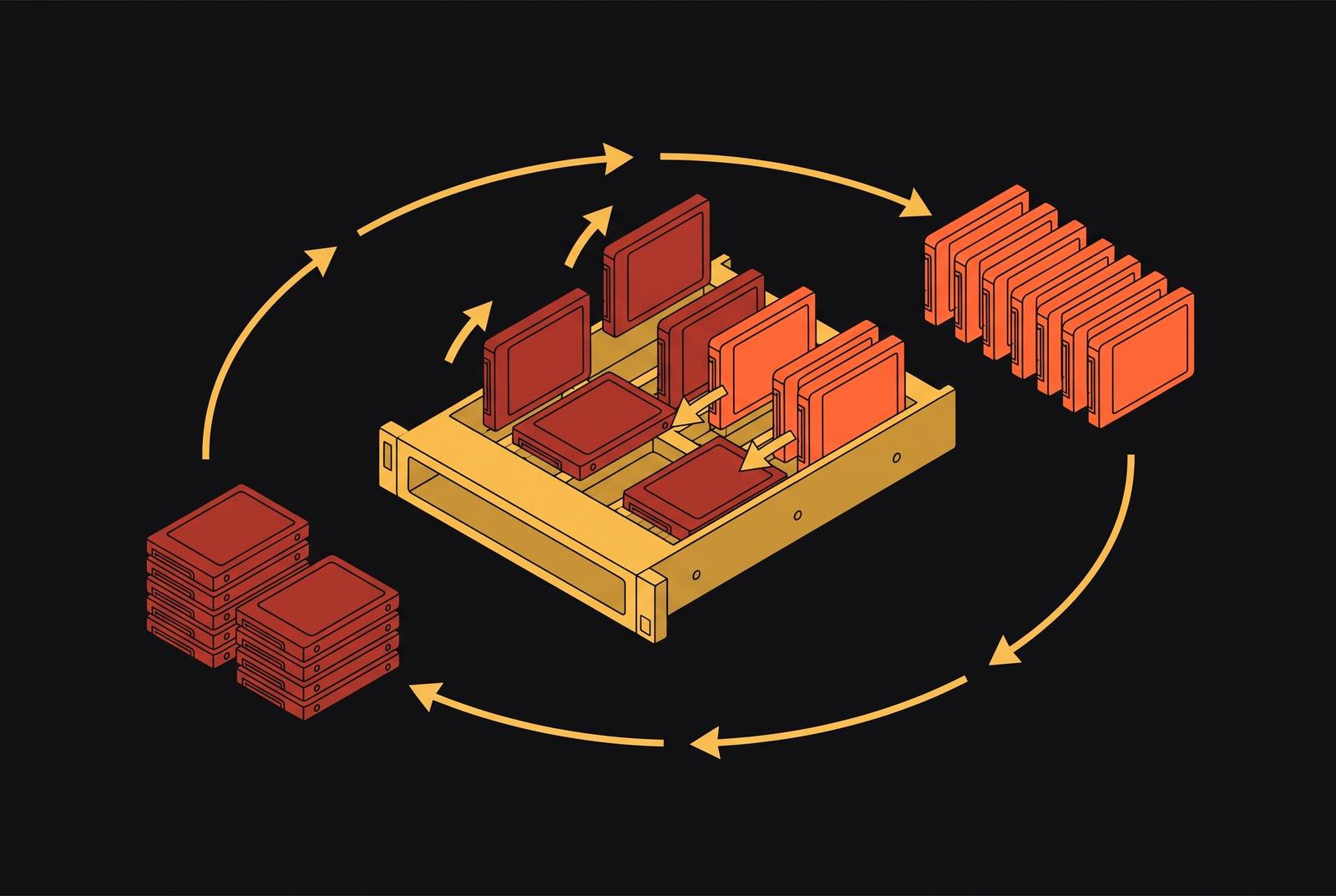
A refresh cycle running every 2 to 3 years generates a decommissioning and sanitization workload that most existing IT asset disposition programs were built for 5-year hardware lifecycles, and those programs can't absorb this pace without being restructured.
The 2025 update to NIST SP 800-88 expanded its scope to cover NVMe drives, M.2 form-factor media, and embedded flash architectures directly, while leaving device-specific technical sanitization detail to IEEE 2883, a standard common in AI server configurations. The update makes clear that if an SSD or NVMe drive is built with over-provisioned storage regions, standard overwrite procedures don't satisfy Purge requirements, because those hidden regions can retain data that a simple overwrite never touches. Drives decommissioned without accounting for that structure carry exposure a conventional server sanitization process wouldn't have left behind.
The window for recovering value from retired AI hardware closes faster than it does for conventional servers. A team that waits until end-of-life to start the decommissioning process, rather than planning for it, will find that residual value has already eroded by the time it acts.
A refresh planning process that accounts for compressed cycles
Planning NVMe refresh cycles for AI workloads calls for a different decision framework than traditional server lifecycle management uses, because the trigger here is workload economics, not a failure event or a depreciation table running out.
Workload characterization comes first: an inference-dominant deployment is read-heavy, can run on QLC NAND, and needs KV cache tiering, while a training-dominant deployment is write-intensive, needs TLC or other high-endurance media, and has its sizing set by checkpoint I/O. These two profiles lead to meaningfully different refresh timelines and media choices, and treating them as interchangeable is where planning goes wrong early. From there, you have to ground endurance budgeting in the actual write patterns a system produces in a KV cache offloading role, calculated from real serving data rather than pulled from manufacturer DWPD ratings, because those ratings were built around generic enterprise workloads that never anticipated AI tiering behavior. Architecture choices made now also shape how much pain later refreshes bring: a disaggregated NVMe-oF setup lets storage get refreshed on its own schedule, separate from the GPU nodes, and a team that builds in that separation today pays a smaller architectural cost at every refresh that follows. Benchmarking belongs in this process as a gate, not an afterthought: the MLPerf Storage v3.0 KV Cache workload test gives teams a standard profile to qualify candidate storage systems against real production inference patterns before any platform decision gets locked in, and you should treat published benchmark results as a floor to clear, not a ceiling to aim for.
The decommissioning plan belongs in the procurement conversation, not the end-of-life conversation. Building NIST SP 800-88 Rev. 2 requirements and ITAD vendor qualification into the procurement checklist from the start means the compliance documentation already exists by the time a system reaches retirement, rather than being assembled under pressure after the fact. Decisions about KV cache tiering, NVMe-oF fabric design, and endurance budgeting for AI-native workloads are specialized enough that getting them right is what separates a system that absorbs a compressed refresh cycle without drama from one that ends up in an emergency procurement scramble at the worst possible point in the supply cycle.