Stranded Asset Risk in AI Infrastructure Investments
Financial models underestimate how fast AI hardware becomes obsolete.
Stranded asset risk in AI infrastructure is not primarily a financial problem, though it arrives disguised as one. It is an engineering problem that financial models are structurally unable to price. The gap between the depreciation schedules that underwrite AI capex and the accelerating compression of effective compute lifespans determines which infrastructure investments remain productive and which quietly become uneconomical long before their accountants notice.
Why AI infrastructure investments strand differently than other capital-intensive asset classes
The historical analogy most often invoked to explain the current AI buildout is partially correct. KKR's November 2025 analysis notes that past overbuilds in rail, electrification, and fiber seeded critical economic change, and the physical layer those investments created persisted for decades. The track laid in the nineteenth century still carries freight. The fiber buried in the late 1990s still lights up the internet. Overinvestment in physical infrastructure has a way of finding a second life because the asset itself does not become obsolete. It becomes underused, then gradually essential.
The analogy breaks down at the compute layer, and it breaks down for a reason that has no historical precedent. A railroad track does not invent a faster mode of transport. A fiber cable does not develop a successor to itself. But an LLM training cluster is actively producing models that reduce the compute needed to run equivalent inference workloads. The infrastructure is not merely being built out in anticipation of demand. It is being used to make the infrastructure itself less necessary per unit of useful work. This is a compounding obsolescence mechanism that earlier capital-intensive buildouts never exhibited.
That mechanism is the core of the argument. Inference efficiency gains compress the economic lifespan of GPU-class hardware faster than depreciation schedules assume, which means the financial models underwriting the current buildout are structurally optimistic at the point of commitment. They are not wrong because their demand forecasts are too high. They are wrong because their asset-life assumptions are calibrated to a world where hardware does not invent its own successors.
How depreciation schedules and actual compute lifespans have diverged
The accounting foundation on which the current cycle rests is a five-to-six-year depreciation schedule for compute hardware, with significantly longer schedules for buildings and power systems. Every financial model in the current expansion uses these figures or something close to them. The assumption is orderly: a GPU cluster generates returns over five or six years, then it is retired or refreshed, and the depreciation clock matches the economic clock closely enough that the difference does not matter.
The technical reality is different. Raw FP16 compute in datacenter GPUs increases even faster, roughly every one and a half years. A cluster that comes online today faces severe competitive disadvantage from the next hardware generation well before its depreciation schedule completes. The asset does not break. It simply becomes uneconomical to operate against hardware that produces the same work for a fraction of the cost.
The financing structure amplifies the consequence. Private credit lenders are modeling AI infrastructure investments on timescales comparable to commercial real estate or telecom towers, a direct mismatch with the actual economic lifespan of the compute inside those facilities. A growing share of hyperscaler capex is now externally debt-financed, per Man Group's analysis. When stranded compute becomes a credit problem, the failure mode propagates beyond the balance sheets of the companies that built the clusters. It reaches lenders who priced the collateral as a long-lived physical asset.
One further distortion makes the mismatch harder to see in real time. The hyperscalers are simultaneously the builders, buyers, and validators of AI infrastructure. The demand signal that would ordinarily provide early warning of overcapacity is recursively generated by the same entities that profit from the buildout. This is not fraud. It is structure. The recursive demand loop means that the first indication of overcapacity will not be a slowing order book. It will be price collapse in the market where capacity is monetized, which is inference.
Why inference price collapse is the most legible signal of hardware obsolescence pressure
The collapse in inference cost per token is not a market pricing anomaly. It is a direct readout of compounding efficiency gains in model architecture, quantization, and serving infrastructure, and it makes the revenue assumptions behind current capex implausible at face value. Each step down in token cost reflects hardware getting more efficient per unit of useful work. That efficiency is real and it is good for the economy, but it means each prior generation of hardware is producing less revenue per GPU-hour than the financial model assumed when the capex was committed.
The self-disruption dynamic compounds the pressure. Open-source models are commoditizing inference capability, enabling enterprises to self-host rather than buy from centralized providers. When an enterprise moves to self-hosted inference, it removes a unit of captive demand that external inference margin assumptions depended on. The infrastructure builders who financed the centralized capacity are left competing against their own customers' hardware.
What matters for infrastructure builders is the timing. When per-token revenue falls faster than the depreciation schedule runs, hardware earns too little over its lifetime before it needs replacing. It strands not because it fails mechanically, but because a more efficient generation has made it uneconomical to operate. The signal to watch is not utilization or uptime. It is the velocity of inference price decline, because that velocity is a direct proxy for the rate at which efficiency gains are consuming the economic usefulness of installed hardware.
How KV cache architecture evolution turns GPU memory into a stranding bottleneck
The first technical mechanism driving this velocity sits in the memory subsystem. KV cache management is the primary reason GPU memory has become a hard constraint in production LLM serving. The KV cache stores key-value attention pairs for each token to avoid recomputation, and as context windows grow, cache size scales linearly with sequence length and concurrently with the number of users. GPU HBM becomes the binding constraint around which the rest of the serving system must be organized.
The architectural direction of KV cache optimization is a direct determinant of what hardware remains useful. Dell Technologies researchers categorize recent KV cache optimization strategies into five principal directions: cache eviction, compression and reconstruction, hybrid memory solutions, novel attention mechanisms, and combination strategies. Each direction has different implications for what storage and memory hardware remains useful. A cluster that is well matched to one strategy can become poorly matched to the next without any change in workload demand.
The most consequential shift is disaggregation. Keeping KV cache state in local SSDs leads to fragmentation across nodes and limits reuse across requests. The conventional per-node approach is now being superseded by centralized, reusable designs that require a different storage topology entirely. NVIDIA's CMX Context Memory Storage platform, announced in 2026, addresses this with a disaggregated intermediate shared storage tier. Hardware acquired for local-cache architectures does not map cleanly onto this new topology without significant infrastructure changes.
The stranding implication is concrete. GPU clusters sized and networked for local KV cache management face a capability cliff as workloads migrate to disaggregated cache architectures. It is not the GPUs that fail. It is the surrounding storage and network topology that no longer fits the serving pattern, and the cluster becomes stranded as a system even though its principal component remains perfectly functional.
How numeric format choices, BF16, FP8, and quantization, interact with hardware generation gaps
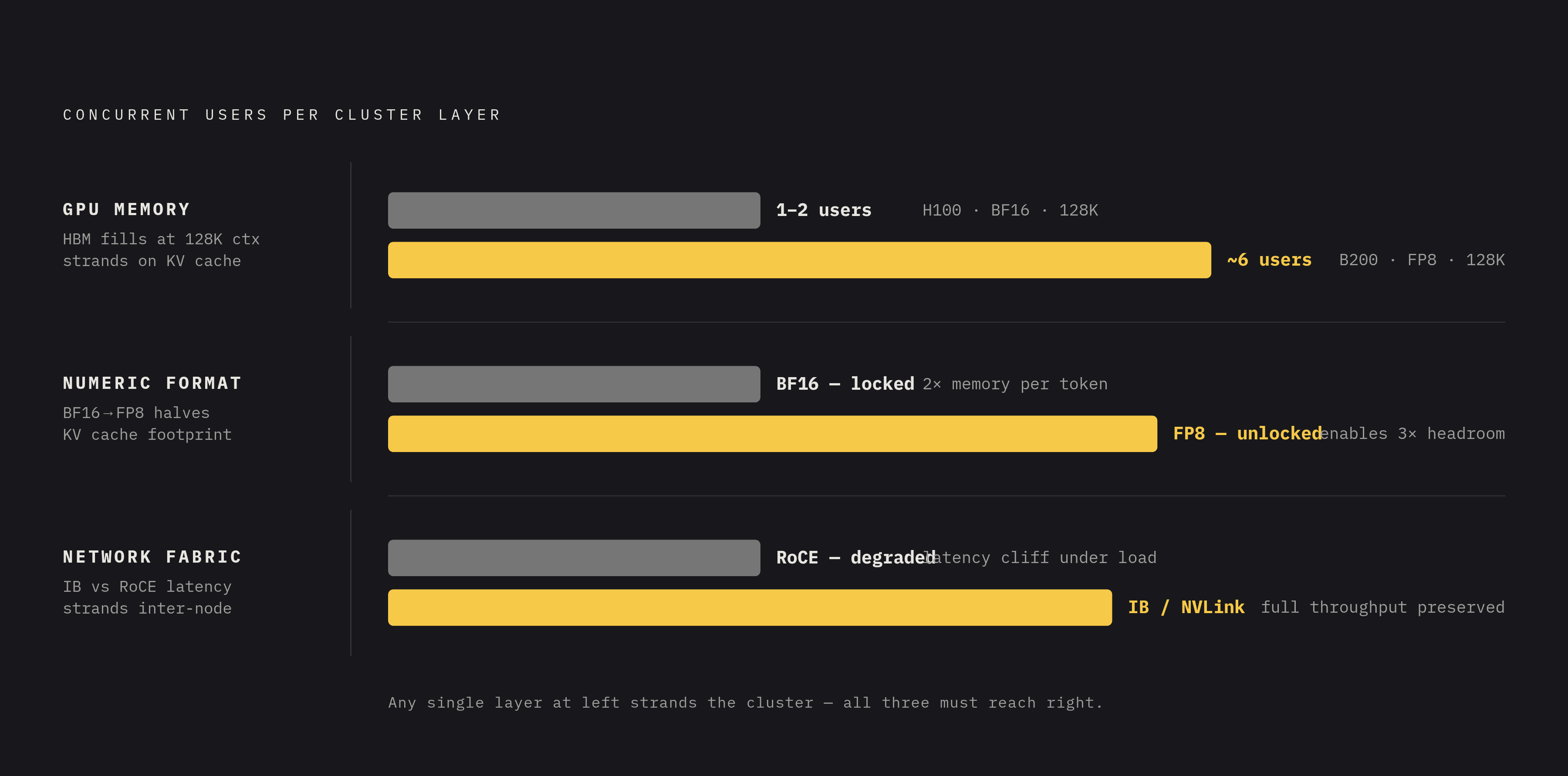
The second mechanism is numeric precision, and it illustrates how a software decision becomes a hardware selection decision. The transition from BF16 to FP8 KV cache quantization is not a software optimization that can be applied uniformly across hardware generations. It creates a concrete capacity boundary that separates hardware that can serve long-context workloads competitively from hardware that cannot.
The magnitude of the boundary is stark. An H100 serving a large model at 128K context has room for only one to two concurrent users at BF16 KV cache fill. FP8 KV quantization allows a B200 to serve roughly six concurrent users without any offload. This is not a marginal efficiency difference. It is a multiple-of-throughput difference that determines whether a cluster can serve long-context workloads at commercially viable concurrency levels.
The boundary cannot be bridged by software alone on H100-class hardware. The HBM capacity is physically fixed, and FP8 inference at production scale requires the tensor core support and memory bandwidth of newer silicon. No amount of serving-layer optimization changes the physical memory ceiling. What this means for infrastructure is that H100-based clusters serving long-context workloads are structurally capacity-constrained relative to B200-class hardware running FP8. The H100 cluster strands not because it stops working, but because it cannot compete on throughput-per-dollar at the workloads that matter most. Quantization format is a hardware selection decision masquerading as a software one.
How network fabric topology lock-in creates a separate and underappreciated stranding vector
The third mechanism sits in the interconnect, and it is the most easily overlooked because network fabric is expensive to replace and rarely interrogated at specification time. Its capability determines whether storage-disaggregated inference is even possible, and the industry has already executed a topology shift that leaves InfiniBand-only fabrics partially stranded for inference workloads. The bandwidth stakes are not abstract. For a large model, KV cache transfer between prefill and decode pools is substantial per request. Bandwidth between two GPUs varies by orders of magnitude depending on physical relationship: 900 GB/s via NVLink 4.0 within a domain versus roughly 50 GB/s via InfiniBand across nodes. A serving pattern that depends on fast cache movement between pools requires the right fabric, and the fabric cannot be upgraded in place. It requires a hardware refresh cycle.
The shift away from InfiniBand is underway. The storage-disaggregation dependency compounds the problem. NVMe-oF with GPUDirect Storage requires RDMA for its direct GPU-memory DMA path. NVMe-oF itself supports a TCP transport that operates over standard Ethernet without RDMA hardware, but GPUDirect Storage's zero-copy benefit is unavailable in that configuration. An InfiniBand or RoCE network with GPUDirect RDMA-capable NICs is required for the full zero-copy path.
This means standard data-center Ethernet installed before the GPU buildout is functionally incapable of supporting storage-disaggregated inference without a full NIC refresh. Infrastructure built to pre-AI-inference specifications cannot support the serving architectures that the most efficient KV cache management requires. The compounding effect is that a cluster with correctly sized GPU memory, running FP8 inference, but connected via a fabric that cannot support disaggregated KV cache transfer at the required bandwidth is still effectively stranded for the workloads where disaggregation matters most.
The three mechanisms interact. GPU memory, numeric format, and network fabric can each strand independently, and stranding at any one layer limits the others. Correct quantization does not help if the fabric cannot move cache state. A fast fabric does not help if HBM capacity cannot hold the cache at concurrency. The topology decisions made today constrain the serving architectures available in two to three years, which is roughly when the depreciation clock is still telling the financial model the cluster has another half of its useful life remaining.
How storage architecture decisions at the NVMe and disaggregated-cache layer affect stranding exposure going forward
Storage is not a passive layer in stranding risk. It is an active determinant of whether a cluster can adapt to evolving cache architectures or becomes locked into an obsolete serving pattern. The choices made now, particularly around NVMe compatibility with GPUDirect paths and disaggregated cache platforms, will determine whether current infrastructure can participate in the next generation of serving architectures or requires replacement.
An industry standard is already forming around a specific storage topology. NVIDIA's Inference Context Memory Storage Platform, announced at CES 2026, extends GPU KV cache into NVMe-based storage and is backed by NVIDIA's NVMe storage partners. The companion Dynamo framework works across a memory and storage hierarchy spanning HBM, CPU DRAM, direct-attached NVMe SSDs, and networked external storage. The full hierarchy must be present and compatible for the platform to function as designed. Storage infrastructure that lacks BlueField-4 DPU support or is incompatible with the ICMSP GPUDirect NVMe path faces functional obsolescence for disaggregated inference workloads without a hardware upgrade cycle. This is a concrete compatibility boundary, not a theoretical one.
The architectural direction is clear. Disaggregated design is preferable to local-SSD approaches because local KV cache storage leads to fragmentation across nodes and limits reuse across requests. The industry is moving toward centralized, pooled storage, which requires purpose-built NVMe infrastructure rather than repurposed general-purpose storage. Infrastructure teams that specify storage with the ICMSP path, RDMA-capable NICs, and GPUDirect compatibility today are buying optionality into future serving architectures. Teams that do not are accepting a narrower capability envelope that may not cover the workloads that matter most as context lengths and concurrency demands grow.
The broader principle is that storage is not a commodity problem for AI inference workloads. It is a first-class engineering constraint that determines whether KV cache management can scale to the concurrency and context lengths that production LLM serving requires, and whether that serving remains economical as hardware generations turn over. The mitigation of stranded asset risk is not found in better financial modeling. It is found in treating storage architecture as the determinant of stranding exposure that it is, and in specifying infrastructure that retains optionality as the cache architectures of the next two to three years come into view.