AI-Optimized Storage Appliances vs. DIY NVMe Deployments
Appliances offer validated integration; DIY saves cost with strong software expertise.
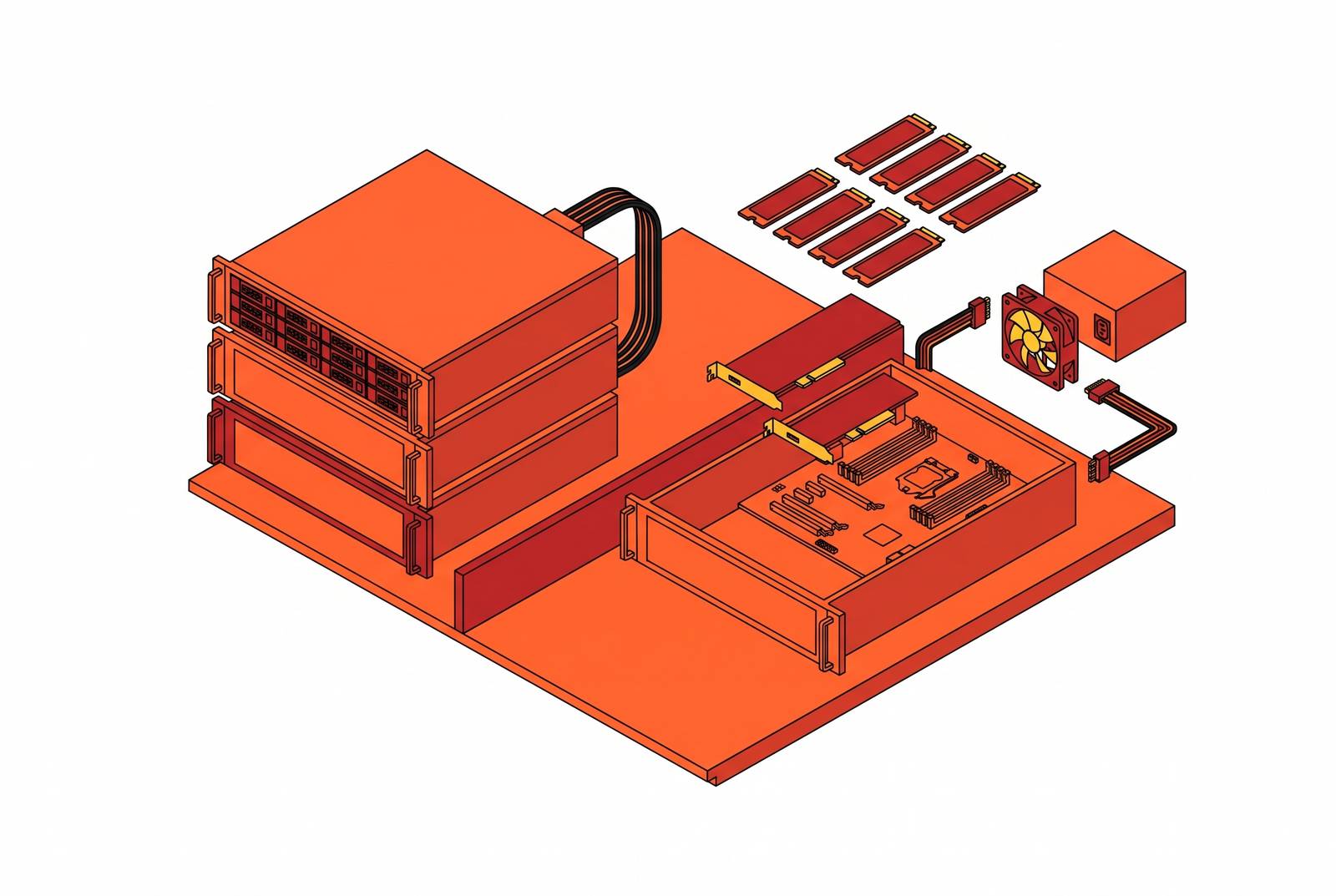
Choosing between AI-optimized storage appliances and DIY NVMe deployments is an infrastructure engineering decision. For open-source LLM inference stack benchmarking and optimization, the decisive criteria are KV cache delivery, bandwidth to the GPU, data locality, operational complexity, and GPU utilization. Appliances earn their premium through validated integration and managed performance, while DIY can close much of the gap when the software stack and infrastructure expertise are strong.
Why storage is the binding constraint in production LLM serving, not just a provisioning afterthought
KV cache overflow forces storage into the inference path. At production concurrency levels, the cache for active requests can grow beyond what GPU HBM can hold, so data must move through the memory hierarchy or serving stalls. HBM3 and NVMe bandwidth differ by orders of magnitude. That gap makes moving cache data a latency problem, rather than simply a question of finding enough space.
Model weights arrive through large sequential reads once per model switch, while KV cache retrieval happens over and over and must finish in time because it is on the critical path of token generation. A system that loads weights quickly therefore has not demonstrated that it can support cache retrieval under concurrency. The production pattern for long-context serving is a three-tier hierarchy spanning GPU HBM, CPU DRAM, and NVMe. In that hierarchy, flash is a live participant in inference latency, so its placement and delivery path become consequential architectural choices.
What the KV cache actually demands from storage at scale
On an H100 serving a large model at long context, one user's KV cache can occupy a substantial fraction of HBM. Longer contexts mean more cache for each request, while more active users mean more cache that must stay available. Without offloading or a smaller cache representation, little headroom remains for concurrency. The storage needed therefore depends on the model, context length, and number of active requests as well as model weight size.
Cached blocks must also arrive quickly enough to support token generation, making retrieval latency and sustained delivery bandwidth separate requirements. Loading cached KV blocks from NVMe is far faster than recomputing a long prefix, and that advantage grows further at million-token RAG scale. NVMe can therefore improve serving performance despite being much slower than HBM. Its value comes from avoiding recomputation, provided the retrieval path delivers the blocks in time.
Cache representation changes those requirements before hardware is chosen. vLLM exposes FP8 KV cache quantization through --kv-cache-dtype fp8, roughly doubling concurrent users on the same hardware by cutting the VRAM footprint. Blackwell supports NVFP4, reducing that footprint further. Smaller cache representations also cut the capacity and bandwidth needed downstream from NVMe. Lossless BF16 compression offers another lever, with codec research showing decode throughput fast enough to leave retrieval network-bound.
The benchmark must reflect these dependencies alongside flash throughput. MLPerf Storage's KV cache benchmark measures simulated LLM output tokens per second summed across all clients. Tokens can only be generated as fast as storage supplies the blocks they depend on, linking storage delivery to serving output. The resulting specification includes cache capacity at the intended context and concurrency, retrieval latency, and aggregate block-delivery bandwidth after quantization or compression. Because the benchmark simulates output, its scope is limited to a storage reference point.
What AI-optimized storage appliances actually offer and where they earn their cost
Appliances come with engineering work done that a DIY team must do itself. Validated, warrantied, benchmark-submitted configurations incorporate I/O scheduling, quality of service, failure-domain management, and fabric integration. Published benchmark rules help teams judge that work with more than a component specification to go on. The premium purchases an integrated system. Its value grows when the team needs a large deployment to behave as expected more than it needs the most performance from a single drive.
Integration validation is a distinct part of that value. NVIDIA-Certified Storage validations covering DGX SuperPOD and BasePOD provide a tested integration guarantee that commodity DIY configurations do not inherit. This reduces the work required to establish that storage and the GPU platform operate together as intended. A validated configuration still has to meet the deployment's cache-delivery and throughput requirements.
MLPerf Storage v3.0 on-premises submissions for checkpointing writes showed a large gap between median and peak efficiency, with the best-performing purpose-built appliances at the top of the distribution. Even so, it shows why raw drive specifications alone cannot tell a team how much work a storage deployment will do for the power it uses.
A shared QLC array served over 100 GbE showed one client reading at over 10 GiB/s, matching the fastest local M.2 measured in the same system class. That comparison establishes a concrete possibility. Purpose-built platforms are also used in hyperscale AI factory deployments, so the evidence goes beyond benchmark submissions.
What DIY NVMe deployments actually offer and where they close the gap
The strongest DIY case begins in the software layer. vLLM and LMCache manage inference and caching, while GDS and io_uring support the I/O path over commodity NVMe. Avoiding prefill recomputation on a cache hit is not an exclusive property of an appliance. A properly configured NVMe tier can provide that benefit through software.
NVMe-oF over RDMA makes disaggregated DIY storage practical. NVMe/RoCE over 100 GbE delivers sub-100 µs latency with zero-copy transfer, while documented testing places the added latency versus local NVMe in the single-digit to low-tens of microseconds. Together AI runs its cache-aware prefill-decode disaggregation hierarchy over RDMA, demonstrating production viability for this approach at meaningful scale. SPDK provides user-space NVMe drivers and NVMe-oF target support. Modern Linux kernels also have NVMe-oF targets, so teams have mature, open tools to build the storage plumbing.
GPU Direct Storage moves data from NVMe directly to GPU HBM through DMA, bypassing the CPU, but it only pays off when the end-to-end path is configured properly. Network work includes jumbo frames at MTU 9000, Priority Flow Control, and RDMA queue depth. Namespace striping and read-ahead sizing for sequential model loads require deliberate configuration as well. These settings need ongoing validation.
In practice, model loading through production inference APIs tops out well below what Gen 5 NVMe can deliver, limiting the model-loading speedup available from choosing Gen 5 over Gen 4. DIY teams must also take care of I/O scheduling, QoS under mixed workloads, failure-domain management, and performance regression detection. Those responsibilities are the principal qualification on the hardware savings. Commodity components can narrow the performance gap, but they do not transfer operational accountability to a vendor.
The four dimensions where the two paths diverge in ways that actually determine outcomes
The first dimension is bandwidth to the GPU. Appliances with purpose-built fabric and many NVMe nodes can deliver aggregate bandwidth that single DIY nodes can match only with the same investment in hardware. DIY NVMe-oF narrows the fabric gap, with an 8-node AI cluster on 100 GbE able to sustain tens of GB/s aggregate when NICs, switches, and fabric are correctly specified and tuned. GDS, io_uring, and SPDK address constraints that fast flash alone cannot overcome, so component bandwidth is not the same as delivered GPU bandwidth.
The second dimension is data locality and residency control. Both paths must manage placement and eviction across HBM, DRAM, and NVMe, but they assign that responsibility differently. Appliances with integrated DPUs can offload I/O scheduling from the GPU host. In DIY configurations, vLLM's paged attention and LMCache handle the logical layer, while the infrastructure team remains responsible for physical I/O. CXL memory pooling offers an emerging DRAM-tier alternative with meaningful speedups over RDMA in research settings, but it requires new server platforms and has not appeared in mainstream MLPerf submissions.
The third dimension is how hard the system is to run under production load. Appliances provide validated QoS under concurrent training and inference workloads, while DIY teams must establish how their own configurations behave under contention and failure. The storage interface itself is also evolving. MLPerf Storage v3.0 added S3 object storage support to POSIX, and working group co-chair Curtis Anderson said that object-based storage may become a workable, and perhaps preferred, choice in place of filesystems at trillion-token context scale. The benchmark also drew many first-time entrants, so buyers and builders have more results to compare, while DIY teams still have to keep track of changes.
The fourth dimension is GPU utilization efficiency. A GPU waiting for KV cache retrieval is not generating tokens, which makes locality and residency control economic concerns as well as latency concerns. Compression can improve this dimension on either path by reducing the data that must be stored and moved. ZipServ at ASPLOS '26 demonstrated lossless BF16 compression with up to 2.21× kernel-level speedup over cuBLAS and 1.22× average end-to-end speedup over baseline vLLM. These kernel and inference results show how compression can alter the economics before storage hardware is compared.
Cost per token is an outcome of all four dimensions. An appliance's aggregate throughput has limited value if software prevents the workload from using it, while lower-cost DIY hardware can lose its advantage when cache retrieval leaves GPUs idle. On the other hand, a team with the right skills can get strong results from commodity storage when it tunes the software and fabric to fix the bottleneck.
How should teams choose storage for their specific LLM serving stack?
The decision should begin with the binding constraint. If the main requirement is validated integration with a specific GPU platform, the appliance path removes integration risk that a DIY team would otherwise absorb. If the constraint is aggregate NVMe bandwidth for large multi-node checkpoint writes, purpose-built many-node systems have a structural advantage over DIY JBOD configurations unless the latter receive equivalent hardware investment. Those are different problems from KV cache reuse. When hit rate and prefix reuse limit high-concurrency inference, LMCache, paged attention, and FP8 quantization provide gains available on either storage path.
At moderate scale, a team with strong infrastructure expertise can use NVMe/RoCE over 100 GbE, SPDK or a kernel NVMe-oF target, and GDS to capture much of the benefit at lower hardware cost. With a few GPU nodes, running a full NVMe-oF fabric often adds more work than it saves. At hyperscale, involving hundreds of GPU nodes, the absence of validated fabric management and QoS can impose more overhead than an appliance premium.
MLPerf Storage's KV cache and checkpointing benchmarks provide audited reference points for both paths, so teams should require vendors to cite results and run the benchmark against DIY configurations before production. The benchmark must also match the claim being evaluated. Checkpointing bandwidth does not show how well a system serves cache data, and a storage benchmark alone does not prove that an open-source inference stack is faster or cheaper than a proprietary API.
Compression should precede the final storage commitment. Using FP8 quantization or lossless BF16 compression on the KV cache cuts the capacity and bandwidth needed, which helps determine the architecture choice and may make a cheaper tier enough. Both paths need an inference server, cache manager, compression codec, and I/O scheduler to make good use of the storage. Storage is a first-class serving problem, but its solution belongs to the whole stack.